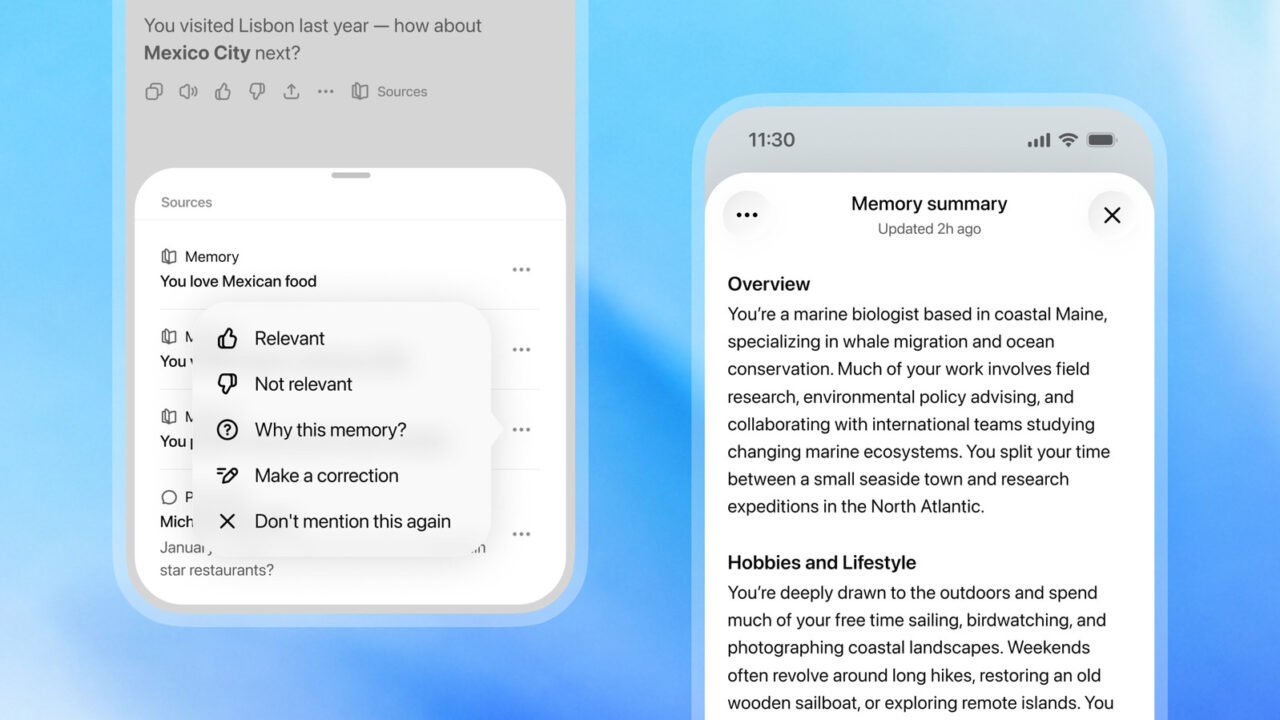
OpenAI has significantly enhanced ChatGPT‘s memory capabilities, particularly benefiting users on the free tier, by improving the chatbot’s underlying “dreaming” architecture. This development marks a substantial evolution from the basic memory features first introduced in April 2024. The improvements aim to make interactions with the AI more coherent and less repetitive over time, directly addressing earlier user feedback regarding memory relevance. This matters right now because it promises a more personalized and efficient AI experience for a wider user base, potentially setting a new standard for conversational AI persistence.
Key Developments
- OpenAI has substantially upgraded ChatGPT’s memory functionality, with a notable impact on free-tier users.
- The core of this improvement lies in advancements to the chatbot’s “dreaming” architecture, operating in the background.
- These enhancements address previous limitations where ChatGPT’s memories became less relevant over time.
- The initial memory feature, launched in April 2024, relied heavily on explicit user prompts for recall.
- The current rollout of these memory improvements began on June 4, 2026.
What Happened
OpenAI initiated a major upgrade to ChatGPT’s memory features on June 4, 2026, targeting an improved user experience across all tiers, with particular emphasis on free accounts. This initiative represents a significant step forward from the initial memory implementation that debuted in April 2024. That early version, known as “saved memories,” was acknowledged by OpenAI itself as rudimentary, requiring explicit user cues for the chatbot to retain information.
Over the subsequent year, OpenAI dedicated resources to developing a more sophisticated system, which they eventually termed “dreaming.” This new architecture operates in the background, allowing ChatGPT to retain context and information more effectively without constant explicit prompting from the user. The goal was to overcome the problem of memory decay, where the chatbot’s recall diminished in relevance as conversations progressed or over time.
The improvements are designed to create a more seamless and personalized interaction, reducing the need for users to repeatedly provide the same information. By evolving from a reactive, prompt-dependent memory system to a proactive, background-driven one, OpenAI aims to make ChatGPT a more intelligent and intuitive conversational partner. This strategic enhancement is expected to redefine user expectations for AI assistants.
Why It Matters
This memory upgrade for ChatGPT holds substantial significance for both the AI industry and its vast user base. For businesses integrating AI into customer service or content generation, enhanced memory means more consistent and context-aware interactions, reducing friction and improving efficiency. Users, particularly those on the free tier, will experience a more intelligent AI that remembers preferences, past conversations, and specific details without constant re-entry, making the tool far more practical for ongoing tasks.
Competitively, this move could solidify OpenAI’s position by offering a superior baseline experience, especially when compared to other AI models that may struggle with long-term conversational coherence. Improved memory directly translates to higher user satisfaction and engagement, which are critical metrics in the fiercely contested AI market. Furthermore, it hints at the future direction of AI development, where contextual understanding and persistent learning become standard features rather than niche capabilities.
From a user perspective, this development directly addresses a common frustration with early AI chatbots: their inability to recall past interactions effectively. By mitigating this, ChatGPT becomes a more reliable assistant for personal productivity, learning, and creative endeavors, fostering deeper engagement and utility across diverse applications.
Industry Impact
The enhanced memory capabilities in ChatGPT are poised to send ripples across the broader AI and technology ecosystem. For developers building on OpenAI’s APIs, the improved underlying model means their applications can inherit more sophisticated conversational intelligence, leading to richer, more personalized user experiences. This could accelerate the development of AI agents capable of maintaining complex, multi-turn dialogues, impacting fields from personalized education to advanced virtual assistants.
Industries relying heavily on conversational AI, such as customer support, healthcare, and financial services, stand to benefit immensely. Imagine a customer service chatbot that remembers your previous inquiries and preferences across sessions, or a medical AI that retains your health history for more accurate diagnostic support. This level of contextual awareness can dramatically improve service quality and operational efficiency. The upgrade also puts pressure on competitors to match or exceed this memory standard, potentially sparking an arms race in conversational coherence among leading AI providers.
Moreover, this development could influence user adoption rates for AI tools. A more intelligent and less frustrating AI experience, particularly for free users, lowers the barrier to entry and encourages wider experimentation and integration of AI into daily routines. This expansion of the user base could lead to more feedback, faster iteration cycles, and ultimately, more advanced and capable AI systems across the board.
Analysis
OpenAI’s strategic investment in improving ChatGPT’s memory, particularly for its free tier, reflects a nuanced understanding of user needs and market dynamics. Early iterations of AI memory were often superficial, relying on explicit commands that broke the illusion of natural conversation. The transition to a “dreaming” architecture, operating in the background, signifies a deeper architectural commitment to contextual intelligence rather than just data recall. This approach suggests a move towards more autonomous AI agents that can build and maintain a persistent understanding of user interactions over time.
The focus on free users is particularly insightful. By enhancing the baseline experience, OpenAI cultivates a broader, more engaged user base that can eventually be upsold to premium features or contribute valuable data for further model refinement. This strategy ensures that the core product remains highly competitive and accessible, acting as a powerful funnel for sustained growth and innovation. The implicit learning happening in the background through the “dreaming” process could also be a subtle mechanism for continuous model improvement, allowing the AI to organically adapt to user patterns and preferences without explicit retraining.
Ultimately, this development underscores the industry’s ongoing push towards more human-like and less transactional AI interactions. The ability of an AI to remember and adapt is fundamental to its perceived intelligence and utility. As these memory capabilities mature, they will enable a new generation of AI applications that are not just tools, but persistent digital collaborators capable of understanding and anticipating user needs over extended periods. This evolution will inevitably raise expectations for all AI platforms, making advanced memory a table stakes feature rather than a differentiator.
Timeline of Key Events
- April 2024 OpenAI ships its first “saved memories” feature for ChatGPT.
- April 2024 – June 2026 OpenAI develops the “dreaming” architecture to improve memory.
- June 4, 2026 Significant enhancements to ChatGPT’s memory, powered by “dreaming,” roll out.
Competitive Landscape
The enhancement of ChatGPT’s memory features, especially for free users, intensifies the competitive pressures within the conversational AI market. Rivals such as Google’s Gemini, Anthropic’s Claude, and Meta’s Llama-based models are all vying for market share by emphasizing unique capabilities, and memory coherence is a critical battleground. While specific details on competitors’ memory architectures are often proprietary, OpenAI’s public rollout of an improved “dreaming” system sets a new benchmark.
This move forces competitors to either accelerate their own memory development or highlight other differentiators such as multimodal capabilities, specialized knowledge domains, or superior reasoning. For instance, if a competitor’s model struggles with maintaining context over long conversations, OpenAI gains a distinct advantage in user experience and retention. The implicit challenge posed by OpenAI is to deliver not just powerful language generation, but also sustained, intelligent interaction that feels natural and personalized.
Smaller AI startups and open-source projects will also feel this impact, as they must now contend with a higher standard of “out-of-the-box” intelligence from a market leader. This could drive further innovation in memory management techniques, potentially leading to new research and development in areas like long-context windows, knowledge graph integration, and personalized AI agents across the industry.
Future Implications
Near-term (3–6 months), expect increased user engagement with ChatGPT as the benefits of improved memory become apparent, potentially leading to higher conversion rates from free to paid tiers. We may also see other major AI providers announce similar memory enhancements to remain competitive, creating a rapid push for more persistent conversational AI. This will likely result in a noticeable reduction in user frustration related to repetitive prompting across the AI landscape.
Medium-term (1–2 years), the enhanced memory will enable the development of more sophisticated AI agents capable of managing complex, multi-stage tasks over extended periods. This could lead to specialized AI assistants that truly understand user workflows, preferences, and long-term goals, moving beyond simple Q&A to proactive assistance. We might also see new business models emerge around highly personalized AI “companions” or “co-pilots” that learn and evolve with the user.
Long-term (3–5 years), persistent and adaptive memory could fundamentally alter human-computer interaction, making AI systems feel less like tools and more like genuine collaborators. This could pave the way for AI to play a more central role in creative processes, strategic planning, and even emotional support, as systems become capable of deep contextual understanding and relationship building. Regulatory discussions around AI data retention, privacy, and personalized AI biases will also intensify as these memory capabilities become more pervasive and powerful.
Actionable Insights
- Experiment with ChatGPT’s free tier to personally assess the improved memory and its impact on your workflows.
- For developers, explore how enhanced memory capabilities in models like ChatGPT can be integrated into your applications to create more coherent user experiences.
- Businesses should evaluate their current AI strategies, considering how persistent memory can improve customer service, content creation, and internal knowledge management.
- Stay informed about competitor announcements regarding memory features, as this area will be a key battleground for AI platforms.
- Provide specific, clear instructions to ChatGPT even with improved memory, as explicit prompts still reinforce desired behaviors and information retention.
What is “dreaming” in ChatGPT?
“Dreaming” refers to a new background architecture developed by OpenAI that allows ChatGPT to retain and process conversational context more effectively. This system works continuously to improve the chatbot’s memory and relevance without requiring explicit user prompts.
How does improved memory benefit free ChatGPT users?
Free ChatGPT users will experience a more coherent and personalized interaction, as the chatbot will remember details from previous conversations. This reduces the need to repeatedly provide the same information, making interactions more efficient and less frustrating.
When did OpenAI first introduce memory features?
OpenAI first introduced a basic memory feature, then called “saved memories,” in April 2024. This initial implementation required strong cues from the user to remember specific facts or details.
Will my past conversations be remembered by ChatGPT?
Yes, with the enhanced memory features, ChatGPT is designed to remember details and context from your past conversations more effectively. This allows for a more continuous and personalized experience across interactions.
Why is improved AI memory important for the industry?
Improved AI memory is crucial for the industry as it enables more sophisticated and human-like AI interactions, driving innovation in personalized AI agents and applications. It also sets a new competitive standard for conversational AI platforms.
Key Takeaways
- OpenAI significantly improved ChatGPT’s memory, especially for free-tier users, starting June 4, 2026.
- The enhancement stems from a new “dreaming” architecture that operates in the background to retain context.
- This upgrade addresses previous limitations where ChatGPT’s memory became less relevant over time.
- The development promises a more personalized and efficient AI experience for a wider user base.
- Improved memory will likely set a new industry standard for conversational AI coherence and user engagement.