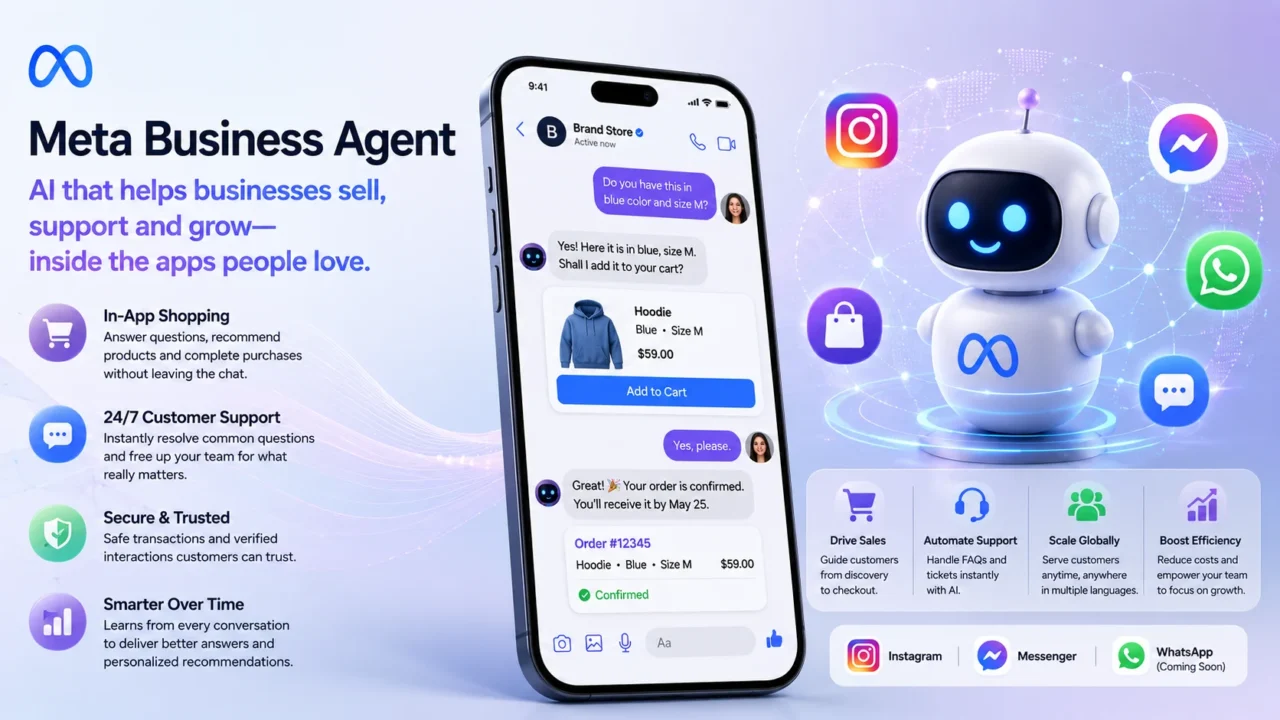
Meta has unveiled its Business Agent, a new AI-powered system designed to automate conversational commerce directly within its suite of messaging applications. This software empowers global retail brands to manage customer transactions and support inquiries without requiring human intervention, fundamentally reshaping how businesses interact with consumers on social platforms. Integrating agentic AI into the core of social commerce workflows on Instagram, Messenger, and soon WhatsApp signifies a major strategic shift. The move addresses the increasing burden on traditional contact centers overwhelmed by high volumes of customer interactions, offering a persistent digital sales representative capable of operating worldwide.
Key Developments
- Meta has launched Business Agent to automate conversational commerce workflows within its messaging applications.
- The software enables global retail brands to execute transactions and handle support tickets without human intervention.
- Agentic AI is now integrated directly into the core of social commerce on Instagram, Messenger, and soon WhatsApp.
- Business Agent operates beyond basic chatbot functionalities, capable of executing concrete administrative tasks.
- The system aims to reduce cart abandonment rates by collapsing the checkout funnel directly within the host application.
What Happened
Meta introduced Business Agent as a sophisticated AI solution to streamline conversational commerce. This new platform is engineered to automate a wide range of customer interactions, from initial product inquiries to final transaction processing, all contained within Meta’s popular messaging services. Its deployment extends across Instagram and Messenger, with future integration planned for WhatsApp, creating a unified ecosystem for brands to engage with consumers.
The core functionality of Business Agent revolves around its ability to act as an autonomous digital sales and support representative. Unlike conventional chatbots that typically offer pre-scripted responses, Meta’s agentic AI can handle complex administrative tasks, guiding customers through detailed processes such as sizing variations for merchandise. This advanced capability allows businesses to manage high volumes of customer interactions efficiently, a significant advantage over traditional contact center models that often struggle with scalability.
One of the most critical aspects of Business Agent is its design to collapse the checkout funnel directly within the messaging applications. For instance, if a consumer discovers an item on Instagram and initiates a chat on Messenger to inquire about product details, the agent intercepts this query. It then seamlessly guides the buyer through the entire checkout process, ensuring the transaction is completed within the messaging environment itself. This architecture is specifically designed to mitigate high cart-abandonment rates often associated with redirecting customers to external payment portals.
Why It Matters
The introduction of Meta Business Agent represents a significant evolution in the landscape of e-commerce and customer service, marking a strategic pivot towards deeply integrated AI within social platforms. This development holds profound implications for how retail brands operate, offering a solution to the long-standing challenge of managing customer inquiries and transactions at scale. By embedding agentic AI directly into its messaging applications, Meta is not just enhancing user experience but fundamentally redefining the customer journey, making it more fluid and less prone to friction points.
For businesses, the impact is substantial, promising massive efficiency gains in support operations and a direct pathway to increased sales conversion. The ability to handle transactions and support tickets without human intervention allows brands to reallocate resources, focus on strategic growth, and provide round-the-clock service. This continuous availability and immediate response capability are critical in today’s global, always-on consumer market, where expectations for instant gratification are high.
The competitive dynamics within the social commerce sphere will also be intensely affected. Meta’s move positions its platforms as not just discovery engines but complete transactional ecosystems, potentially drawing more retail brands to deepen their reliance on Instagram, Messenger, and WhatsApp for direct sales. This could set a new standard for conversational commerce, compelling other platforms to develop similar integrated AI solutions to remain competitive.
Industry Impact
Meta Business Agent is poised to exert a substantial influence across the broader AI and technology ecosystem, particularly within retail, customer service, and marketing technology sectors. The direct integration of sophisticated AI agents into high-traffic social platforms demonstrates a viable model for automating complex business processes that previously required significant human capital. This could accelerate the adoption of agentic AI solutions across various industries looking to enhance operational efficiency and customer engagement.
Retail companies, irrespective of size, stand to benefit immensely from this technology. Small businesses can access enterprise-level customer service capabilities without the associated overhead, while large global brands can scale their support and sales operations to unprecedented levels. This democratisation of advanced AI tools will likely drive innovation in how products are discovered, discussed, and purchased online. The model of a persistent digital sales representative operating globally could become a benchmark for consumer-facing roles.
Beyond retail, the principles demonstrated by Business Agent could inspire similar applications in other service-oriented industries. Financial services, travel, and healthcare providers, for instance, might explore integrating agentic AI into their own customer interaction channels to manage inquiries, process bookings, or even assist with administrative tasks like appointment scheduling. The success of Meta’s platform could validate the broader utility of AI agents capable of executing concrete administrative tasks, moving beyond simple information retrieval.
Analysis
Meta’s strategic deployment of Business Agent represents a calculated move to solidify its position at the nexus of social interaction and commercial activity. By embedding advanced AI directly into its messaging applications, the company is not merely offering a new tool but is attempting to fundamentally redefine the digital shopping experience. This initiative signals a clear understanding of contemporary consumer behavior, where discovery often begins on social media, and the desire for immediate, frictionless transactions is paramount. The platform’s ability to guide a buyer from initial query to completed purchase within the same application addresses a critical pain point in e-commerce: cart abandonment due to external redirects and fragmented user journeys.
The decision to place agentic AI at the core of social commerce also reflects a broader industry trend towards intelligent automation that extends beyond basic chatbot functionality. Business Agent’s capacity to execute concrete administrative tasks—such as processing transactions or fielding detailed support tickets—distinguishes it from earlier, more limited conversational AI solutions. This deeper level of integration and autonomy positions Meta’s offerings as comprehensive commerce platforms rather than just communication channels. The implications for contact centers are profound, as the technology promises to alleviate the strain of high interaction volumes, potentially allowing human agents to focus on more complex or sensitive customer issues.
Furthermore, this development solidifies Meta’s competitive stance against other e-commerce platforms and social media rivals. By creating a persistent digital sales representative that operates globally, Meta is building a sticky ecosystem where brands can cultivate and convert customer relationships directly. This strategic move not only enhances the utility of Instagram, Messenger, and WhatsApp for businesses but also reinforces their value proposition to users, who can now complete their shopping journeys more efficiently. The architectural model of collapsing the checkout funnel directly within the host application is a sophisticated approach to improving conversion rates, demonstrating Meta’s commitment to facilitating end-to-end commercial activities within its digital footprint.
Competitive Landscape
The launch of Meta Business Agent intensifies competition within the rapidly evolving conversational AI and social commerce sectors. While Meta leverages its immense user base across Instagram, Messenger, and WhatsApp, other technology giants and specialized platforms are also vying for dominance in automating customer interactions and transactions. Companies like Google, with its AI capabilities, and Amazon, with its established e-commerce infrastructure, possess the resources and technological prowess to develop competing agentic AI solutions tailored for commerce. However, Meta’s advantage lies in the inherent social fabric of its platforms, where product discovery and peer recommendations are already deeply ingrained.
E-commerce platforms such as Shopify and Salesforce also offer various integrations and tools for conversational commerce, often relying on third-party AI solutions or their own CRM-driven automation. These platforms typically focus on providing merchants with a comprehensive toolkit for online sales, including chatbot integrations for customer service. Meta’s approach, however, directly embeds the transactional capabilities within the social messaging environment, potentially offering a more seamless and less fragmented user experience. This direct integration could compel existing e-commerce platforms to accelerate their own development of native, agentic AI solutions to keep pace with Meta’s offerings and prevent merchants from consolidating their social commerce efforts solely on Meta’s properties.
Specialized conversational AI companies, which provide chatbot and virtual assistant solutions to businesses, may also face increased pressure. As Meta offers a comprehensive, integrated agentic AI directly within its ecosystem, brands might find less need to seek external vendors for basic conversational commerce functionalities. This could lead to a consolidation of services or force these specialized AI companies to innovate further, focusing on niche applications or more complex, industry-specific AI solutions that Meta’s general-purpose agent might not cover. The overall trend suggests a future where AI-powered conversational commerce becomes a standard feature, with platforms competing on the depth of integration, intelligence of the agent, and breadth of administrative tasks it can execute.
Future Implications
In the near-term (3–6 months), Meta Business Agent will likely see rapid adoption among global retail brands already active on Instagram and Messenger, eager to streamline their customer service and sales funnels. Expect an increase in transactional activity directly within Meta’s messaging apps as businesses experiment with the agent’s capabilities. This period will also see Meta refining the agent’s AI based on real-world interaction data, improving its ability to handle diverse queries and administrative tasks.
Medium-term (1–2 years) predictions suggest that the success of Business Agent will spur other major social media and e-commerce platforms to develop and integrate their own advanced agentic AI solutions for conversational commerce. This will lead to a more competitive landscape, with platforms differentiating on AI sophistication, integration depth, and industry-specific functionalities. We could also see the emergence of a new class of AI-powered digital sales representatives becoming standard for online businesses, fundamentally altering traditional contact center models.
Long-term (3–5 years), the widespread deployment of agentic AI in social commerce could significantly reshape consumer expectations for online shopping. Customers may come to expect instant, personalised, and fully transactional interactions directly within their preferred messaging apps, rendering external payment portals and fragmented customer service experiences obsolete. This could also lead to new regulatory considerations regarding AI ethics, data privacy, and consumer protection within automated transactional environments.
Actionable Insights
- Evaluate existing customer service and sales funnels to identify areas where Meta Business Agent could automate interactions and reduce cart abandonment.
- Begin strategizing for the integration of agentic AI into social commerce workflows, particularly on Instagram and Messenger, to prepare for WhatsApp’s eventual inclusion.
- Assess current contact center operations for potential efficiency gains by offloading high-volume, routine inquiries and transactions to AI agents.
- Explore how a persistent digital sales representative could enhance global reach and provide 24/7 customer support without geographical or time constraints.
- Prioritise the development of rich product content and clear FAQs that an AI agent can effectively use to guide customers through the purchase process.
- Investigate the capabilities of Business Agent beyond basic chatbots, focusing on its capacity to execute concrete administrative tasks and streamline the entire checkout process.
What is Meta Business Agent?
Meta Business Agent is an AI-powered software launched by Meta to automate conversational commerce workflows directly within its messaging applications like Instagram and Messenger. It allows retail brands to execute transactions and field support tickets without human intervention.
Which Meta platforms will integrate Business Agent?
Business Agent is currently integrated into Instagram and Messenger, with future deployment planned for WhatsApp. This creates a unified ecosystem for brands to manage customer interactions and transactions.
How does Business Agent reduce cart abandonment?
The agent intercepts customer queries within the messaging app and guides buyers through the entire checkout process inside that host application. This architectural model eliminates the need for external payment portals, which often lead to high cart-abandonment rates.
What specific tasks can Meta Business Agent perform?
Beyond basic chatbot parameters, Business Agent can execute concrete administrative tasks, such as guiding buyers through sizing variations, processing transactions, and fielding support tickets. It acts as a persistent digital sales representative.
What is the main benefit for retail brands using Business Agent?
Global retail brands gain massive efficiency in support operations and can execute transactions directly within Meta’s messaging apps. This allows for scalability, 24/7 availability, and a more streamlined customer journey, reducing the burden on traditional contact centers.
Key Takeaways
- Meta Business Agent automates conversational commerce directly within Instagram, Messenger, and soon WhatsApp.
- The AI software allows global retail brands to execute transactions and manage support tickets without human agents.
- Business Agent integrates agentic AI into social commerce, operating beyond basic chatbot functionalities.
- Its design collapses the checkout funnel within the host application, aiming to reduce cart-abandonment rates.
- This platform creates a persistent digital sales representative capable of operating globally, enhancing operational efficiency for businesses.