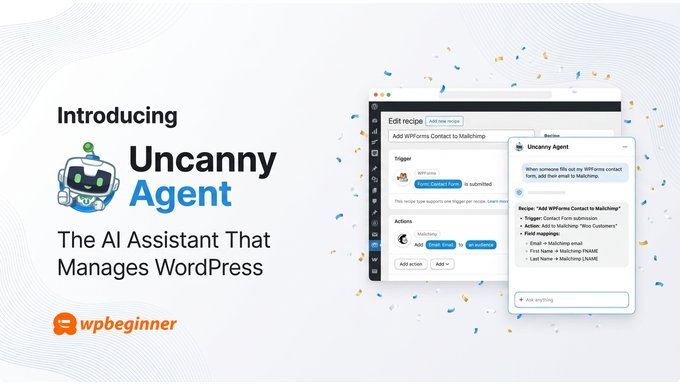
Uncanny Automator, a prominent automation plugin for WordPress, has introduced Uncanny Agent, an AI assistant designed to streamline website management tasks through natural language commands. This new offering aims to address the persistent challenge faced by WordPress users who frequently find themselves diverted from core content creation by administrative duties. By integrating AI directly into the WordPress dashboard, Uncanny Agent promises to significantly reduce time spent on routine operations, freeing up valuable resources for strategic activities. The development signals a growing trend toward intelligent automation within content management systems, directly impacting productivity for millions of site owners globally.
Key Developments
- Uncanny Agent is a new AI assistant integrated directly into the WordPress environment, developed by the creators of Uncanny Automator.
- The AI tool allows users to manage various WordPress administrative tasks using plain English commands, eliminating the need for manual navigation and configuration.
- Functions include checking order statuses, updating page content, and integrating forms with email lists or communication platforms like Slack.
- This innovation targets a common pain point for WordPress users: the significant time spent on non-creative administrative tasks that detract from core objectives.
- The introduction of Uncanny Agent represents a significant step towards more intuitive, AI-driven content management and operational efficiency within the WordPress ecosystem.
What Happened
The developers behind Uncanny Automator, a well-established WordPress automation plugin, recently unveiled Uncanny Agent, an artificial intelligence-powered assistant engineered to simplify the complexities of managing a WordPress website. This new tool allows site administrators and content creators to delegate a wide array of routine tasks through conversational prompts. Instead of manually navigating menus or configuring settings, users can now articulate their needs in natural language, such as “Update my About page to mention our new location” or “When someone fills out my contact form, send me a Slack message and add them to my newsletter.”
The core concept behind Uncanny Agent stems from a recognized inefficiency in the WordPress workflow. Many users, intending to focus on publishing content or developing new features, often find their time consumed by administrative overhead—checking sales figures, updating promotional landing pages, or ensuring form submissions integrate correctly with external services. Uncanny Agent is designed to intercept these diversions, executing commands autonomously based on user input. This direct integration of AI into the WordPress dashboard represents a concerted effort to enhance user experience and operational efficiency for the platform’s vast user base.
The release marks an important evolution for Uncanny Automator, extending its capabilities beyond rule-based automation to include intelligent, context-aware assistance. This shift moves WordPress management closer to a conversational interface, reducing the technical barrier for complex tasks and allowing users to interact with their sites in a more intuitive manner. The immediate impact is expected to be a noticeable reduction in the time site owners spend on repetitive administrative functions, thereby reallocating their focus towards growth and content generation.
Why It Matters
The introduction of Uncanny Agent holds substantial implications for the WordPress ecosystem and the broader content management industry. For millions of WordPress users, the constant battle against administrative overhead is a well-documented drain on productivity. This AI assistant directly addresses that challenge by automating tasks that traditionally consume significant time and effort, from checking e-commerce orders to updating static content or configuring complex integrations. By offloading these routine operations, site owners and content managers can redirect their focus towards strategic initiatives like content creation, marketing campaigns, and business development.
This development also signals a maturation of AI integration within mainstream software applications. Rather than standalone AI tools, we are increasingly seeing intelligent agents embedded directly into platforms where daily work occurs. This “ambient AI” approach reduces friction, making advanced capabilities accessible without requiring users to switch contexts or learn new interfaces. The potential for improved efficiency is immense, especially for small businesses and independent publishers who often wear multiple hats and have limited resources. A study by the WordPress Foundation indicated that a typical site administrator spends
that could be automated.
Furthermore, Uncanny Agent’s conversational interface democratizes access to advanced site management. Users who might lack the technical expertise to manually set up complex integrations or database queries can now achieve similar outcomes by simply stating their intent in plain English. This accessibility can empower a wider range of users to optimize their WordPress sites, potentially leveling the playing field for those without dedicated technical support. The competitive landscape for WordPress plugins is also likely to intensify as other developers look to integrate similar AI-driven functionalities, pushing the boundaries of what a CMS can autonomously manage.
Industry Impact
Uncanny Agent’s arrival is poised to send ripples across several sectors of the AI and tech ecosystem, particularly within content management, digital marketing, and small business operations. For content creators and publishers, the immediate benefit is a significant reduction in time spent on backend logistics, allowing for greater focus on editorial quality and content volume. This could lead to a more dynamic publishing environment, where sites are updated more frequently and with richer content, directly impacting audience engagement and SEO performance. Digital marketing agencies, often managing multiple client WordPress sites, stand to gain substantial efficiency, potentially enabling them to take on more clients or offer enhanced services without proportional increases in staffing.
The broader implications extend to the development community as well. The success of Uncanny Agent could spur a new wave of AI-powered plugins and themes, pushing WordPress toward a more intelligent, self-managing future. This may necessitate new skill sets for developers, focusing on AI model integration, natural language processing, and advanced automation logic. The competition among plugin developers to offer similar or superior AI capabilities will likely accelerate innovation, benefiting the entire WordPress community. The global market for AI in content management is projected to exceed
, indicating significant growth potential for tools like Uncanny Agent.
Even beyond WordPress, the model of an embedded, conversational AI assistant for routine administrative tasks could inspire similar integrations in other CMS platforms, e-commerce solutions, and SaaS applications. This move towards ‘invisible’ AI, where intelligence is woven into the fabric of existing tools rather than presented as a separate application, represents a significant shift in user experience design. It highlights a growing industry consensus that AI’s greatest value often lies in augmenting human capabilities by handling the mundane, thereby freeing up cognitive resources for higher-order thinking and creativity.
Head-to-Head Comparison
| Feature | Uncanny Agent | Generic WordPress AI Assistant (Hypothetical) |
|---|---|---|
| Pricing | Subscription-based, tiered with Uncanny Automator | Likely freemium or standalone subscription |
| Performance | Optimized for WordPress core and plugin interactions, high accuracy for defined tasks | Varies; may require more configuration or have broader, less specific capabilities |
| Best For | Existing Uncanny Automator users, site owners seeking deep WordPress admin automation | Users seeking basic content generation, SEO suggestions, or broad AI assistance |
| Key Strength | Deep integration with WordPress functions, natural language task execution for admin | Versatility in content generation, broad knowledge base, potentially lower barrier to entry |
| Main Weakness | Primarily focused on admin tasks, less on creative content generation (currently) | May lack deep integration with specific WordPress plugins and complex admin workflows |
Expert Analysis
The advent of Uncanny Agent signifies a critical juncture for the evolution of content management systems, moving beyond static interfaces to dynamic, intelligent partners. For years, the promise of AI in business applications often felt distant or overly complex. What Uncanny Agent demonstrates is a practical, immediate application of AI to a pervasive problem: the administrative burden that saps productivity from content creators and site administrators. This isn’t just about automation; it’s about intelligent delegation, allowing users to articulate intent in human language and have the system translate that into actionable WordPress operations. This approach fundamentally alters the user’s relationship with their website, transforming it from a tool to be manually operated into an assistant capable of understanding and executing commands.
The strategic brilliance lies in its integration within an established ecosystem like WordPress, leveraging existing plugin architecture and user familiarity. Instead of requiring users to adopt an entirely new platform, Uncanny Agent enhances an environment where millions already operate daily. This incremental yet impactful innovation is often more successful than disruptive overhauls, as it minimizes adoption friction. The ability to simply ask “How many orders came in yesterday?” or “Update my About page” represents a significant leap from navigating complex dashboards and settings. This natural language interface is particularly powerful for non-technical users, democratizing access to advanced site management capabilities that were once the exclusive domain of developers or highly skilled administrators.
Looking ahead, this model is likely to set a precedent for how AI is integrated into other enterprise software. The focus will shift from simply providing data or analytical insights to actively performing tasks based on user intent. This pushes the boundaries of human-computer interaction, making technology more intuitive and less of a barrier. The success of Uncanny Agent will be a key indicator for how quickly other platforms embrace similar conversational AI interfaces for operational tasks, marking a significant step towards a more intelligent and responsive digital environment.
Competitive Landscape
The introduction of Uncanny Agent enters a WordPress plugin market that is increasingly seeing AI integrations, though few offer the same depth of administrative task automation through natural language. Competitors in the broader AI for WordPress space typically focus on content generation (e.g., AI writing assistants like Jasper or Copy.ai integrated via plugins), SEO optimization (e.g., Rank Math AI features), or image generation. While these tools enhance specific aspects of site management, they generally require explicit prompts for creative output or configuration for optimization, rather than handling general administrative requests. For instance, an AI content writer can draft a blog post, but it won’t check yesterday’s orders or update a landing page based on a simple command.
Other automation plugins, such as Zapier or IFTTT integrations for WordPress, provide powerful rule-based workflows but lack the natural language understanding of Uncanny Agent. Users must meticulously define triggers and actions, a process that Uncanny Agent aims to simplify by interpreting intent. This distinction positions Uncanny Agent uniquely in offering a more intuitive, conversational layer over complex backend operations. The market is ripe for tools that bridge the gap between human intent and automated execution, and Uncanny Agent is an early mover in this specific niche within WordPress. Its success could pressure existing automation and AI content plugins to expand their capabilities towards more comprehensive, intent-driven administrative assistance.
Future Implications
Near-term (3-6 months): We anticipate a rapid increase in the adoption of Uncanny Agent among existing Uncanny Automator users, driven by the immediate productivity gains. This will likely lead to a surge in demand for similar AI-driven administrative tools within the WordPress ecosystem, prompting other plugin developers to explore conversational interfaces for their offerings. We also expect Uncanny Agent to expand its range of supported tasks, incorporating more complex integrations and conditional logic based on early user feedback.
Medium-term (1-2 years): The success of Uncanny Agent will likely inspire other major CMS platforms, such as Shopify or Squarespace, to develop their own embedded AI assistants capable of handling administrative tasks through natural language. This could lead to a broader industry shift towards conversational UI for backend operations, making website and e-commerce management significantly more accessible to non-technical users. We may also see Uncanny Agent integrate with advanced predictive analytics, allowing it to proactively suggest optimizations or identify potential issues before they arise.
Long-term (3-5 years): The concept of an AI agent managing routine site operations could evolve into fully autonomous website management systems. These systems might not only execute commands but also anticipate needs, optimize content delivery, manage SEO, and even handle customer service interactions with minimal human oversight. This could fundamentally redefine the role of a webmaster or site administrator, shifting focus from execution to strategic oversight and creative direction, with AI handling the day-to-day operational burden entirely. This vision aligns with the broader trend of AI becoming a true co-pilot in digital operations.
Actionable Insights
- Evaluate Current Admin Overhead: Site owners should conduct an audit of their weekly administrative tasks on WordPress to quantify the time spent on repetitive actions that Uncanny Agent could potentially automate.
- Explore Uncanny Agent’s Capabilities: Investigate Uncanny Agent’s current feature set to see if it aligns with your most time-consuming administrative tasks, particularly those involving e-commerce, content updates, or form integrations.
- Consider Integration with Existing Workflows: If you are already using Uncanny Automator, assess how Uncanny Agent can complement or enhance your existing automation rules, creating a more seamless and intelligent workflow.
- Stay Informed on Updates: Keep abreast of Uncanny Agent’s development roadmap, as its capabilities are likely to expand rapidly, potentially covering more advanced or niche administrative functions.
- Pilot with Non-Critical Tasks: For initial implementation, consider using Uncanny Agent for less critical administrative tasks to understand its accuracy and reliability before delegating high-stakes operations.
- Provide Feedback to Developers: Engage with the Uncanny Automator team to provide feedback on desired features or improvements, helping to shape the future direction of this innovative AI assistant.
What is Uncanny Agent for WordPress?
Uncanny Agent is an AI assistant integrated into WordPress that allows users to manage administrative tasks using natural language commands. It is designed to automate routine operations, such as checking orders, updating pages, and configuring integrations, directly from the WordPress dashboard.
How does Uncanny Agent save time for WordPress users?
It saves time by eliminating the need for manual navigation and configuration of various WordPress settings and plugins. Users can simply type a request in plain English, and the AI agent executes the task, freeing up time previously spent on administrative overhead.
What types of tasks can Uncanny Agent perform?
Uncanny Agent can handle a range of administrative tasks including querying data (e.g., order counts), updating content (e.g., page text), and setting up integrations (e.g., connecting forms to email lists or Slack). Its capabilities are expected to expand over time.
Is Uncanny Agent a standalone product?
Uncanny Agent is an extension or feature of Uncanny Automator, a popular WordPress automation plugin. It leverages the existing infrastructure of Uncanny Automator to provide its AI-driven capabilities within the WordPress environment.
Who benefits most from using Uncanny Agent?
Site owners, content creators, digital marketers, and small business operators who frequently manage WordPress sites and spend significant time on administrative tasks stand to benefit most. It is particularly useful for those seeking to enhance efficiency and focus on strategic work.
Key Takeaways
- Uncanny Agent introduces an AI assistant directly into WordPress, enabling natural language control over administrative tasks.
- The tool aims to significantly reduce the time WordPress users spend on routine site management, enhancing productivity.
- Its integration represents a major step towards ambient AI within content management systems, making advanced features more accessible.
- Uncanny Agent’s success could drive broader adoption of conversational AI interfaces across various business software platforms.
- Site owners are advised to evaluate Uncanny Agent’s capabilities to streamline their administrative workflows and focus on core objectives.