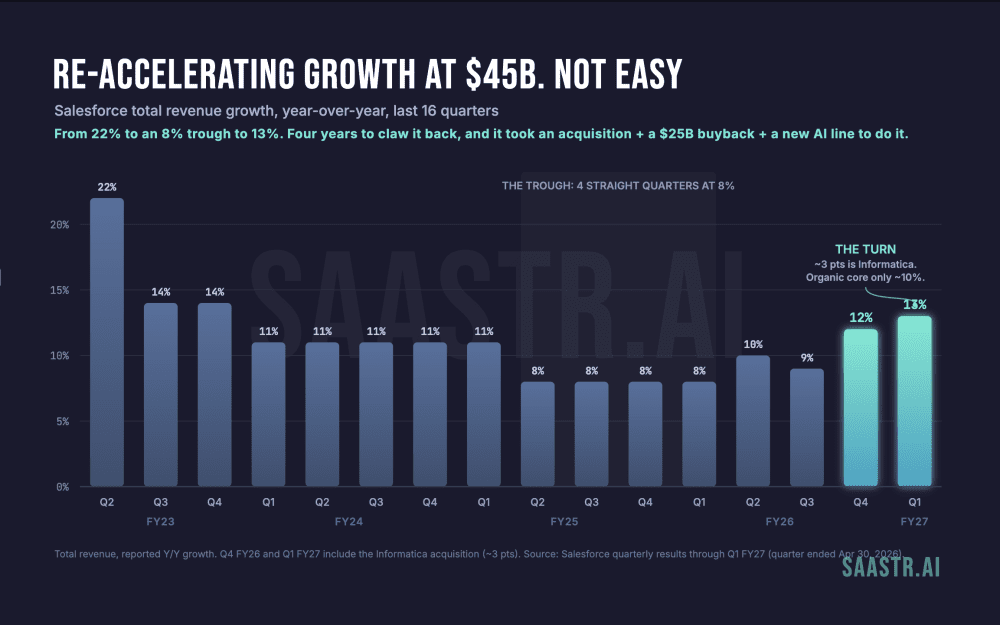
Salesforce, the CRM titan, defied the gravitational pull of the law of large numbers on May 27th, reporting a stunning reacceleration in growth for Q1 FY27. Total revenue surged by 13%Total Revenue Growth Q1 FY27, while subscription growth, a critical metric for SaaS giants, jumped from 9% to 12% in constant currency. This remarkable turnaround comes as many B2B SaaS stalwarts like HubSpot and Workday have seen their growth rates decelerate into the low teens, struggling against market headwinds and the sheer scale of their operations. For professionals in AI and tech, Salesforce’s achievement offers a rare blueprint for reigniting momentum in an increasingly competitive and AI-driven enterprise landscape.
The Unyielding Challenge of Reaccelerating at Scale
Reaccelerating growth for a company operating at an annual recurring revenue (ARR) north of $45 billionSalesforce’s Current ARR is an anomaly in the B2B SaaS world. The mathematical realities dictate that as a company grows larger, it requires an exponentially greater amount of new revenue just to maintain its existing growth percentage. Most companies eventually succumb to this pressure, settling into a lower, more stable growth trajectory. This is why the recent struggles of once high-flying companies to maintain their pre-pandemic growth rates are widely understood and, to some extent, expected.
The enterprise software market has seen a general slowdown, with many established players grappling with extended sales cycles and tighter IT budgets. Salesforce’s ability to not only stabilize but actively increase its growth rate is a testament to a multifaceted strategy that goes against the prevailing trend. It signals a potential shift in how large enterprises can continue to expand their footprint, even when conventional wisdom suggests they should be slowing down.
AI Investment: The New Growth Catalyst
A key differentiator for companies that have managed to reaccelerate growth in the current climate appears to be a significant commitment to AI. While many enterprise software providers are integrating AI features, those who have truly leaned into the AI budget wave are seeing tangible returns. Datadog and Snowflake, for instance, have both experienced growth reacceleration and corresponding positive stock market reactions by deeply embedding AI capabilities into their core offerings.
Salesforce’s emphasis on its AI strategy, including its Einstein Copilot and Data Cloud initiatives, has clearly resonated with customers. This isn’t just about adding AI as a checkbox feature; it’s about fundamentally reshaping how customers interact with their CRM and how data is utilized to drive business outcomes. The willingness of enterprises to allocate significant budget towards AI solutions is creating a new avenue for growth that larger, more established players can capitalize on, provided they execute effectively.
Strategic Acquisitions and Ecosystem Expansion
Salesforce’s history is replete with strategic acquisitions that have expanded its product portfolio and market reach. While specific details of recent acquisition impacts weren’t highlighted in the Q1 report, the company’s consistent strategy of integrating new technologies and platforms plays a crucial role in its ability to offer comprehensive solutions. This ecosystem approach allows Salesforce to capture a larger share of customer spend by providing a unified platform for sales, service, marketing, and commerce.
The ability to present a holistic solution that addresses multiple pain points within an organization becomes even more critical in a market where customers are looking to consolidate vendors and simplify their tech stacks. Salesforce’s continued focus on building out its platform, both organically and through M&A, creates a powerful flywheel effect that helps drive sustained customer engagement and expansion.
Product Innovation Beyond Core CRM
While CRM remains Salesforce’s bread and butter, its reacceleration is also a result of successful diversification and product innovation beyond its traditional offerings. The growth of Data Cloud, for example, is a significant factor. By helping customers unify and activate their data across various systems, Salesforce is solving a critical enterprise challenge that extends far beyond just managing customer interactions.
This expansion into adjacent, high-value segments allows Salesforce to tap into new budget pools and provide more mission-critical services. Companies are increasingly looking for platforms that can not only manage their workflows but also provide actionable insights from their vast data reserves. Salesforce’s commitment to evolving its product suite ensures it remains relevant and indispensable to its vast customer base.
Customer Centricity and Retention at Scale
At its core, Salesforce’s enduring success and recent reacceleration are built on a foundation of deep customer relationships and strong retention. For a company of its size, retaining existing customers and expanding their usage is just as important as acquiring new ones. Salesforce’s focus on customer success, ongoing support, and continuous product improvement fosters loyalty and creates opportunities for upsells and cross-sells.
In a competitive market, customer satisfaction is paramount. Salesforce’s ability to consistently deliver value, adapt to changing customer needs, and address enterprise-level challenges ensures that its massive installed base continues to invest in its platform. This strong customer foundation provides a stable revenue stream and a fertile ground for introducing new AI-powered features and services.
What does “reaccelerated growth” mean for a company like Salesforce?
Reaccelerated growth means that a company’s revenue growth rate has increased after a period of slowing down or deceleration. For Salesforce, this is significant because it’s a massive company, and maintaining or increasing growth at such a large scale is exceptionally difficult due to the law of large numbers.
Why is Salesforce’s growth reacceleration unusual in the B2B SaaS market?
It’s unusual because most large B2B SaaS companies, like HubSpot and Workday, have been experiencing growth deceleration over the past 18 months. The bigger a company gets, the more new revenue it needs to add just to keep its growth percentage stable, making reacceleration a rare feat.
What role did AI play in Salesforce’s recent growth?
Significant investment and integration of AI, particularly through initiatives like Einstein Copilot and Data Cloud, appear to be a major factor. Companies that have leaned into AI budgets are seeing growth reacceleration, indicating that AI is a powerful new catalyst for enterprise software adoption and expansion.
Key Takeaways
- Salesforce achieved a rare feat by reaccelerating its subscription growth from 9% to 12% in constant currency for Q1 FY27, despite its massive $45B+Salesforce’s ARR annual recurring revenue.
- The company’s success challenges the conventional wisdom that large B2B SaaS enterprises inevitably face declining growth rates due to the law of large numbers.
- Strategic investment in AI, particularly through offerings like Einstein Copilot and Data Cloud, has emerged as a critical driver for renewed enterprise spending and growth.
- Salesforce’s comprehensive platform strategy, product innovation beyond core CRM, and strong customer retention are essential components of its ability to sustain and increase momentum.