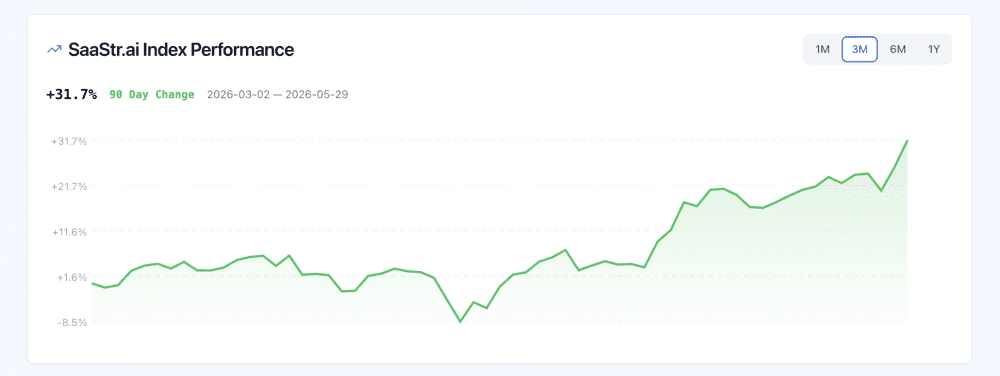
Salesforce shares surged 9% following a robust earnings beat, signaling a broader recovery in the public software sector after its most challenging start to the year on record. This significant rebound, which has seen the aggregate losses from earlier sell-offs largely pared, marks a critical inflection point for an industry that faced unprecedented investor skepticism just months ago. The shift indicates renewed confidence in established software giants, driven by strong financial performance and strategic pivots. For professionals navigating investment and strategic planning in the tech sector, understanding this market correction and its underlying drivers is essential for informed decision-making.
Key Developments
- The public software index has returned to positive territory for 2026, recovering from its worst-ever start to a year.
- This market resurgence represents a substantial bounce from the March 2026 lows, rather than a full return to previous all-time highs.
- Infrastructure-as-a-Service (IaaS) and platform companies are primarily driving the cap-weighted index’s green performance.
- Despite the index-level recovery, the median software company continues to emerge from a significant downturn.
- Several prominent software firms, including Salesforce, HubSpot, and Snowflake, have reported strong earnings or growth, contributing to the sector’s positive momentum.
What Happened
The public software sector, after enduring its most severe market downturn at the start of 2026, has officially navigated its way back into positive territory. At the index level, the collective losses experienced during the initial sell-off have been substantially mitigated, with a notable portion of the software group now posting impressive year-to-date gains. This dramatic reversal began to accelerate following the market bottom in March 2026, demonstrating a powerful resurgence in investor confidence.
Individual company performances have played a crucial role in this sector-wide recovery. Salesforce, a bellwether for enterprise software, saw its stock climb 9% on the day of its clean earnings beat, exceeding analyst expectations. Similarly, HubSpot experienced a 10% increase, reflecting strong demand for its marketing and sales automation tools. Perhaps most striking, Snowflake’s shares rocketed an astonishing
in a single week, propelled by earnings that highlighted significant AI-driven growth and adoption, pulling the broader market tape upward.
Even companies that investors had largely written off just two months prior are now showing signs of life. Firms like Twilio, Okta, Datadog, and ServiceNow, which faced considerable pressure earlier in the year, have begun to stabilize and recover. This broad-based improvement, albeit uneven, signals a fundamental re-evaluation of software valuations and growth prospects, particularly those demonstrating clear pathways to profitability and leveraging emerging technologies like AI.
Why It Matters
The end of the “SaaSpocalypse” and the return to green for the public software index is more than just a statistical anomaly; it signifies a recalibration of market expectations and a renewed focus on fundamental value in the technology sector. For businesses, this shift impacts everything from M&A strategies to talent acquisition, as investor appetite for growth at all costs has been replaced by a demand for sustainable, profitable expansion. The rebound suggests that fears of a prolonged tech winter were perhaps overblown for well-managed companies with strong product-market fit.
This market correction also redefines competitive dynamics. Companies that successfully navigated the downturn by focusing on efficiency, customer retention, and strategic innovation are now poised to capitalize on renewed investor interest. Those that failed to adapt may find themselves further behind. The emphasis on AI-driven results, as exemplified by Snowflake’s dramatic surge, highlights the increasing importance of integrating advanced technologies to drive tangible business outcomes, influencing product roadmaps across the industry.
For users of SaaS products, this rebound could translate into a more stable and innovative vendor landscape. Companies with stronger financial footing are better positioned to invest in R&D, enhance product features, and provide superior customer support. Conversely, weaker players might face continued pressure, potentially leading to consolidation or service disruptions. The overall health of the public software market directly influences the quality and reliability of the digital tools that underpin modern business operations.
Industry Impact
The resurgence of the public software sector carries significant ramifications across the entire AI and technology ecosystem. Venture capital firms, which had tightened their belts considerably during the downturn, may find renewed confidence in backing promising software startups, particularly those with clear paths to profitability and innovative AI applications. This could lead to an uptick in early-stage funding and a revitalization of the startup landscape. The valuation multiples for private companies, which often mirror public market trends, are likely to stabilize or even increase, making future IPOs or M&A exits more viable.
Beyond funding, the recovery influences strategic partnerships and technological roadmaps. Companies that demonstrated resilience and continued growth during the lean months, often by integrating AI into their core offerings, are now seen as more attractive partners for enterprises undergoing digital transformation. The strong performance of infrastructure-focused names suggests that the foundational layers of cloud computing and data management remain critical investment areas, irrespective of broader market volatility. This reinforces the long-term trend towards cloud adoption and sophisticated data architectures.
Specific industries, from financial services to healthcare and manufacturing, rely heavily on SaaS solutions for their operational efficiency and innovation. A healthy software market ensures a steady stream of advanced tools, from CRM and ERP systems to specialized AI platforms. The renewed investment in public software companies means these critical sectors can expect continued evolution and improvement in the digital tools they depend on daily. For instance, the demand for robust cybersecurity and compliance tools remains high, irrespective of market cycles, indicating sustained growth for companies like Okta and Datadog.
Expert Analysis
The current market dynamics in public software present a nuanced picture, one that requires careful discernment beyond headline index performance. While the overall basket is indeed recovering, it is crucial to recognize that this is not a uniform ascent. The strength is heavily concentrated in certain segments, particularly those demonstrating tangible AI integration and clear profitability profiles, which masks the ongoing struggles of a significant portion of the market.
This recovery is largely being carried by the large-cap, established players and infrastructure providers. These companies possess the scale, customer base, and R&D budgets to weather economic headwinds and pivot towards high-growth areas like generative AI. Their performance skews the cap-weighted index, creating an impression of widespread recovery that isn’t reflected in the median software company’s journey, many of which are still deep in a valuation hole and facing intense pressure to prove their business models.
The implication for the broader tech landscape is a continued bifurcation. Companies with strong fundamentals, diversified revenue streams, and a clear AI strategy will continue to attract capital and talent. Conversely, those without these attributes will face sustained pressure, potentially leading to increased consolidation, strategic divestitures, or even outright failures. This period will separate the truly resilient and innovative from those that merely rode the previous bull market wave.
Market Reaction
The market’s reaction to the public software rebound has been overwhelmingly positive, reflected in significant stock movements and a palpable shift in investor sentiment. The cap-weighted index turning green for 2026 after a brutal start is a clear signal that the capital markets are regaining confidence in the sector’s long-term growth prospects. This is evidenced by the impressive individual performances of key players: Salesforce’s 9% jump on strong earnings, HubSpot’s 10% surge, and Snowflake’s remarkable 49% rally driven by AI-powered results, which collectively lifted the entire sector.
Analyst ratings have begun to reflect this renewed optimism, with several firms upgrading software stocks and increasing price targets for companies demonstrating strong financial health and strategic advantage in AI. While some analysts caution that this is a bounce from a low rather than a return to peak valuations, the consensus suggests a more stable and predictable environment for software investments. This positive market reaction is also likely to influence private market valuations, potentially easing the funding crunch for later-stage startups that have struggled to raise capital at favorable terms over the past year.
Competitor responses have varied. Established players are emphasizing their own AI initiatives and demonstrating financial discipline, while smaller, privately held companies are intensifying their efforts to secure funding and prove their viability in a more demanding investment climate. The competitive landscape is now characterized by a clear differentiation between companies that have successfully adapted to the post-pandemic economic realities and those still struggling to find their footing. This resurgence underscores the importance of innovation and robust business models in securing investor confidence.
Future Implications
Near-term (3-6 months): We will likely see continued bifurcation in the software market, with top-tier companies demonstrating AI-driven growth maintaining strong momentum, while others face ongoing pressure to prove profitability. Expect a modest increase in M&A activity as stronger companies acquire struggling but strategically valuable assets. Venture capital funding for AI-native software startups will begin to thaw, but with much stricter investment criteria focused on revenue and unit economics.
Medium-term (1-2 years): The integration of generative AI capabilities will become a baseline expectation for most enterprise software solutions, moving beyond a niche feature to a core component. This will drive significant R&D investment and product development cycles across the industry. We anticipate a wave of “AI-first” IPOs, where companies built from the ground up on AI principles successfully debut on public markets, provided they demonstrate sustainable business models. Consolidation among vertical SaaS providers will accelerate as market leaders seek to expand their offerings and customer base.
Long-term (3-5 years): The software industry will likely experience a profound transformation, with AI becoming deeply embedded in every layer of the technology stack, from infrastructure to application. This could lead to the emergence of entirely new categories of software and business models, potentially disrupting established giants. The global competitive landscape will intensify, with AI innovation becoming a key battleground, influencing geopolitical dynamics and technological leadership. Data governance and AI ethics will move from compliance concerns to fundamental competitive differentiators, shaping consumer and enterprise trust.
Actionable Insights
- Re-evaluate your software vendor portfolio, prioritizing solutions from financially stable companies demonstrating clear AI integration and strong customer support.
- For investors, carefully analyze individual software company fundamentals, focusing on profitability, efficient growth, and tangible AI strategy rather than relying solely on index performance.
- Businesses should accelerate their internal AI adoption strategies, identifying key areas where AI-powered software can drive efficiency, innovation, or competitive advantage.
- Software developers and product managers should prioritize skill development in AI, machine learning, and data engineering to align with evolving industry demands.
- Enterprise IT leaders should conduct thorough due diligence on emerging AI software vendors, ensuring they meet robust security, scalability, and integration requirements.
- Consider strategic partnerships with AI infrastructure providers to build a resilient and future-proof technology stack, leveraging their expertise and scale.
What does “SaaSpocalypse” refer to?
The “SaaSpocalypse” describes the severe market downturn experienced by public software-as-a-service (SaaS) companies in early 2026, characterized by significant stock price declines and investor skepticism regarding valuations and growth prospects.
Why did public software stocks recover in 2026?
Public software stocks recovered in 2026 due to strong earnings reports from key players like Salesforce and HubSpot, and exceptional AI-driven growth from companies like Snowflake. This rebound was also a significant correction from the market’s March 2026 bottom.
Are all software companies performing equally well in this recovery?
No, the recovery is not uniform. While the cap-weighted index is green, primarily driven by large infrastructure and platform companies, the median software company is still climbing out of a deep hole. Performance is bifurcated, favoring those with strong fundamentals and AI integration.
How is AI influencing the software market recovery?
AI is significantly influencing the recovery by driving growth and investor interest, particularly in companies like Snowflake that demonstrated substantial AI-driven results. The ability to integrate and leverage AI is becoming a key differentiator for software firms attracting capital.
What does this recovery mean for future software investment?
The recovery signals a shift towards valuing profitability, efficient growth, and tangible AI strategies over pure growth at any cost. Investors will likely scrutinize business models more closely, favoring companies with strong fundamentals and clear pathways to sustainable success.
Key Takeaways
- The public software index has officially moved back into positive territory for 2026, recovering from its most challenging start to a year.
- This rebound is a significant recovery from the March 2026 market lows, driven by strong performances from major players like Salesforce, HubSpot, and Snowflake.
- The recovery is primarily carried by large-cap infrastructure and platform companies, with the median software firm still facing challenges.
- Investor confidence has returned, but with a renewed focus on profitability, efficient growth, and the tangible integration of AI into product offerings.
- The end of the “SaaSpocalypse” marks a crucial recalibration for the tech industry, influencing future investment, M&A, and strategic development.