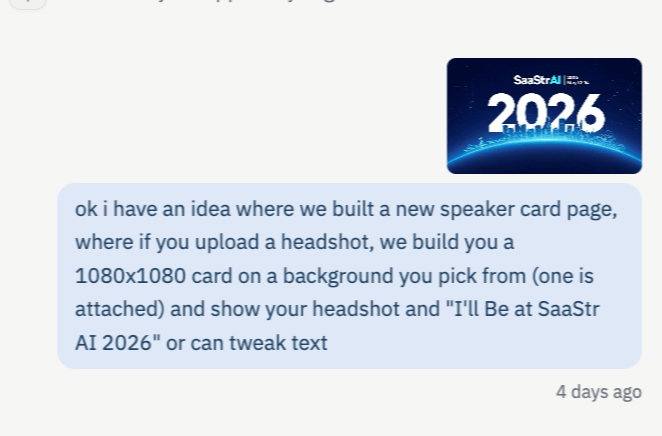
Replit recently demonstrated the startling efficiency of modern AI agents, building a fully functional “speaker card” web page from a single, unformatted sentence and a background image. The AI agent constructed the entire page—including headshot upload, circular cropping with a glowing border, multiple background options, and editable text fields—and then integrated it into the site router with a footer link. This entire process, from a rudimentary prompt to a verified, deployable web component, took a mere
. This capability fundamentally alters the timeline and resource allocation for prototyping and feature development within SaaS companies.
The Era of “Good Enough” Prompts
The traditional approach to software development often involves meticulous planning, detailed specifications, and iterative design cycles. Developers spend significant time translating abstract ideas into concrete requirements before a single line of code is written. This rigorous process is designed to minimize errors and ensure the final product aligns perfectly with the initial vision, but it is inherently time-consuming and resource-intensive.
However, the Replit example illustrates a stark departure from this established methodology. The AI agent successfully interpreted a vague, conversational prompt, inferring intent and filling in the gaps to produce a functional output. This highlights a growing trend where AI tools are becoming adept at understanding context and generating code even from imperfect instructions, accelerating the initial stages of development.
From Idea to Deployment in Minutes
The speed at which the AI agent operated is perhaps its most compelling feature. Building a web page with complex functionalities like image uploads, cropping, and dynamic text fields typically requires a front-end developer, a designer, and potentially a back-end engineer for routing and export features. Each of these roles contributes to a timeline that usually spans days, if not weeks, for even a simple feature.
By contrast, the AI agent condensed this multi-role, multi-day process into minutes. It not only generated the code but also handled integration and verification, presenting a ready-to-use component. This dramatically reduces the barrier to entry for non-technical founders and product managers who can now rapidly test and iterate on ideas without significant engineering overhead.
Democratizing Software Creation
The ability to build functional software from simple prompts democratizes the creation process, extending it beyond the traditional confines of engineering teams. Product managers can now quickly prototype features to gather early feedback, marketers can generate custom landing pages on the fly, and even non-technical entrepreneurs can bring their ideas to life with minimal coding knowledge. This shifts the focus from writing perfect code to refining the initial concept.
This accessibility has profound implications for innovation cycles within SaaS. Companies can experiment more freely, launch MVPs faster, and respond to market demands with unprecedented agility. The cost and time associated with initial development phases are drastically reduced, enabling a broader range of ideas to be explored and tested.
The Power of Contextual AI Agents
What makes these AI agents so effective is their ability to understand and interpret context, even from unstructured input. Unlike earlier code generators that required precise syntax and detailed instructions, modern AI agents leverage large language models to infer user intent. They can fill in missing details, make reasonable assumptions, and generate code that is both functional and aligned with the user’s implicit goals.
This contextual understanding extends to design principles and user experience best practices. For instance, the AI agent in the Replit example automatically implemented a circular crop with a glowing border—design elements that were not explicitly requested but are common and aesthetically pleasing. This demonstrates an emergent intelligence that goes beyond simple code generation to encompass basic design sensibility.
Rethinking Development Workflows in SaaS
For SaaS companies, this evolution in AI-driven development necessitates a re-evaluation of current workflows. Engineering teams can shift their focus from building foundational components to tackling more complex architectural challenges, optimizing performance, and integrating sophisticated features. Repetitive or standard UI tasks can be offloaded to AI agents, freeing up valuable developer time.
Furthermore, the rapid prototyping capability enables a tighter feedback loop with users. Instead of mockups or wireframes, product teams can present functional prototypes generated by AI, allowing for more realistic testing and validation. This iterative approach can lead to products that are more closely aligned with user needs and deliver value faster.
How are AI agents able to build software so quickly?
AI agents leverage advanced large language models and code generation capabilities to interpret natural language prompts, infer user intent, and generate functional code. They can automate repetitive coding tasks and integrate components rapidly.
Does this mean human developers will become obsolete?
No, human developers will likely shift their focus to higher-level tasks such as architectural design, complex problem-solving, AI agent supervision, and ensuring code quality and security. AI agents augment, rather than replace, human expertise.
What kind of software can these AI agents build today?
Currently, AI agents are proficient at building web components, simple web pages, basic applications, and automating routine coding tasks. Their capabilities are rapidly expanding to handle more complex and integrated software solutions.
Key Takeaways
- AI agents can now build functional web components and pages from highly informal, unstructured prompts within minutes.
- This capability significantly reduces the time and resources required for prototyping and initial feature development in SaaS.
- The democratization of software creation allows non-technical professionals to rapidly test and iterate on product ideas.
- SaaS companies can re-evaluate their development workflows, enabling engineering teams to focus on more complex, strategic tasks.