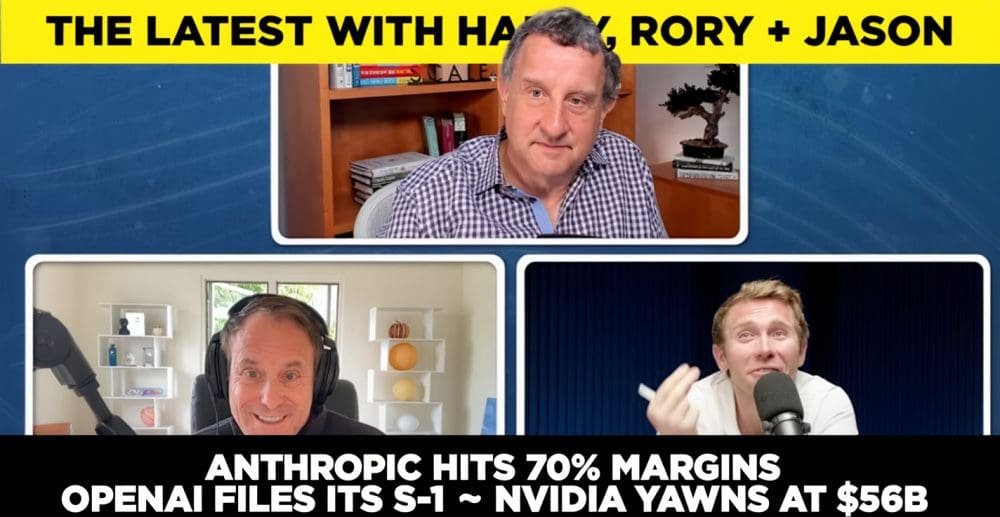
Nvidia reported an astonishing $58 billionQuarterly Profit in a single quarter, a figure that now positions it as the most profitable company globally, yet its stock barely registered the news. This financial titan’s unprecedented success, alongside whispers of an OpenAI S-1 filing and Anthropic’s impressive 70% margins, dominated discussions during the recent 20VC x SaaStr episode featuring Harry Stebbings and Rory O’Driscoll. Every conversation, from infrastructure funding to recent layoffs, ultimately converged on a singular, critical question for the tech industry: what is the optimal balance between human effort and AI-driven automation, and what fate awaits those who miscalculate this delicate equilibrium? This ongoing re-evaluation of human-token synergy is not just a theoretical debate; it’s actively reshaping market dynamics and workforce strategies right now.
Nvidia’s Profit Juggernaut and Market Apathy
Nvidia’s latest earnings report delivered a stark reminder of its dominance in the AI infrastructure space. Generating $81.6 billionQuarterly Revenue in revenue, the company’s $58 billionQuarterly Profit in profit for the quarter is a figure that historically would send shockwaves through the financial markets. Instead, the market’s reaction was muted, a testament to the already sky-high expectations placed on the chipmaker.
This calm response suggests that Nvidia’s extraordinary performance is now largely priced into its valuation, indicating a mature understanding by investors of its indispensable role in the AI build-out. The implication is clear: while Nvidia continues to print money, its growth trajectory is now seen as a baseline rather than an anomaly, signaling a new phase of market sentiment where even record-breaking profits are met with a shrug.
The Looming OpenAI S-1 and Anthropic’s Margin Masterclass
The tech world is abuzz with speculation surrounding an impending OpenAI S-1 filing, a move that would pull back the curtain on one of the most closely watched AI companies. This potential public offering signifies a maturation of the generative AI market and will provide unprecedented insight into the financial health and operational strategies of a leading AI developer. The details within such a filing will undoubtedly set benchmarks and expectations for the entire sector.
Meanwhile, Anthropic, another major player in the AI landscape, has quietly achieved 70%Anthropic’s Operating Margins operating margins, a remarkable feat that underscores the potential for profitability in advanced AI development. This high margin indicates efficient operations and strong demand for their AI models, offering a glimpse into the financial viability of companies focused on ethical and safety-conscious AI. Their success provides a powerful counter-narrative to the perception that AI development is solely a capital-intensive endeavor with distant returns.
The Human-Token Conundrum: A Central Question
Across all discussions, from the financial performance of tech giants to the specifics of startup funding, a singular theme emerged: the optimal division of labor between human intelligence and AI tokens. This isn’t merely a philosophical debate but a practical concern impacting everything from product development to organizational structure. Companies are actively grappling with how much to automate versus how much to retain human oversight.
The “human-token split” dictates efficiency, cost structures, and ultimately, a company’s competitive edge. Getting this balance right means optimizing workflows and resource allocation, while misjudging it could lead to significant operational inefficiencies or a loss of critical human expertise. This fundamental question is shaping investment decisions, hiring strategies, and the very future of work across the tech ecosystem.
Layoffs, Infrastructure, and the Vibe Coding Phenomenon
Recent waves of layoffs across the tech sector, even amidst a booming AI market, highlight the ongoing restructuring driven by AI adoption. Companies are re-evaluating their workforce needs as automation takes over tasks previously performed by humans, leading to a leaner operational model. This trend underscores the immediate impact of the human-token split on employment figures.
Simultaneously, massive infrastructure rounds continue to flow into AI, funding the compute power necessary to train and deploy increasingly complex models. This dual trend—job displacement in some areas, massive investment in others—paints a complex picture of an industry in flux. Even “vibe coding,” a term describing the intuitive, often less structured approach to early-stage AI development, is part of this larger conversation, questioning where human creativity and intuition fit within an increasingly automated development pipeline.
Rethinking Value: Beyond Traditional Metrics
The sheer scale of Nvidia’s profits, coupled with the high margins seen at companies like Anthropic, forces a re-evaluation of traditional business metrics in the AI era. Profitability is no longer just about revenue growth but also about the efficiency of AI-driven operations and the ability to scale intelligence. The value proposition of AI companies is shifting from mere technological prowess to demonstrable economic impact.
This new landscape demands that businesses and investors look beyond conventional indicators to understand true value creation. The ability to effectively integrate AI, optimize human-token collaboration, and generate significant economic returns will be the defining characteristics of successful ventures. The market is increasingly rewarding companies that can demonstrate this strategic foresight and execution.
What is the “human-token split” in AI?
The “human-token split” refers to the strategic decision of how much work should be performed by human employees versus automated by AI models (tokens). It’s a critical operational and strategic question for companies determining efficiency and resource allocation in the age of AI.
Why did Nvidia’s stock barely move despite record profits?
Nvidia’s stock saw a muted reaction despite $58 billionQuarterly Profit in profit because its extraordinary performance is largely already priced into its current valuation. Investors have high expectations for its role in AI, making even record-breaking results less surprising.
What do Anthropic’s 70% margins signify for the AI industry?
Anthropic’s 70% operating margins demonstrate that significant profitability is achievable in advanced AI development, even for companies focused on ethical AI. It indicates strong demand and efficient operational models within the sector, challenging the notion that AI is solely a high-burn, long-return investment.
Key Takeaways
- Nvidia’s $58 billionQuarterly Profit quarterly profit solidifies its position as the world’s most profitable company, yet market reaction was largely subdued due to high expectations.
- The impending OpenAI S-1 filing and Anthropic’s impressive 70%Anthropic’s Operating Margins operating margins highlight the increasing financial maturity and profitability potential within the generative AI sector.
- The central question facing the tech industry is the optimal balance between human effort and AI automation, profoundly impacting workforce, investment, and operational strategies.
- Despite massive AI infrastructure investments, recent tech layoffs underscore a fundamental restructuring of the workforce as companies redefine roles in an AI-driven economy.