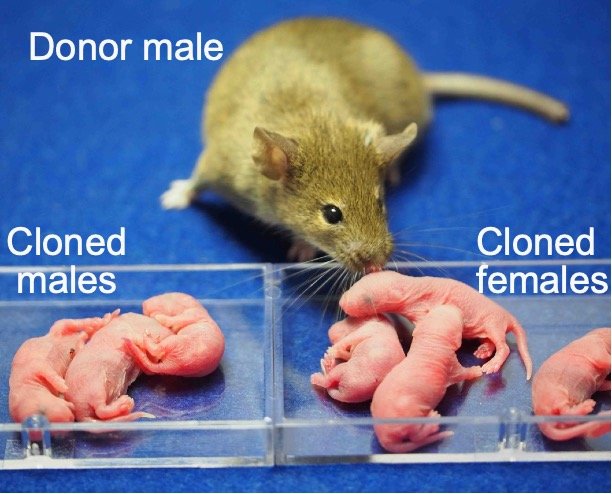
Japanese scientists have achieved a significant biological milestone, successfully transforming male mouse embryos into females and creating female clones from male mice for the first time. This unprecedented feat, detailed in a preprint paper on bioRxiv, leverages a CRISPR-based technique to eliminate the Y chromosome from male cells, fundamentally altering the conventional understanding of mammalian reproduction. The breakthrough not only opens new avenues for genetic engineering but also presents a powerful tool for conservation efforts, particularly for endangered species facing severe population imbalances.
Key Developments
- Scientists in Japan have for the first time deliberately converted male mouse embryos into females using a CRISPR-based method.
- The research team successfully created female clones from male mice by removing the Y chromosome, challenging long-held reproductive paradigms.
- The developed technique, dubbed Y-CUT, targets a crucial section of the Y chromosome to ensure its elimination during cell division.
- The resulting XO female mice were healthy and fertile, capable of reproducing with male clones to produce healthy offspring.
- This innovation holds substantial promise for rescuing endangered species, especially those with dwindling female populations or only male survivors.
What Happened
A research team led by Takashi Ishiuchi of the University of Yamanashi and Shogo Matoba of the Riken BioResource Research Center developed a novel CRISPR-based tool, named Y-CUT, to precisely target and remove the Y chromosome from male mouse cells. Their inspiration stemmed from observing sex-changing fish like the Okinawa rubble goby, which can adapt its sex for reproduction in specific environmental conditions. In their initial experiments, early-stage male mouse embryos treated with Y-CUT were transferred into surrogate mothers, resulting in the birth of female pups.
These female pups possessed an XO chromosomal configuration, meaning they had a single X chromosome instead of the typical XX. Remarkably, these XO females developed into healthy, fertile adults. Building on this success, the scientists then applied Y-CUT to create female clones from male mice. This involved taking the nucleus from an adult male cell, inserting it into an enucleated egg cell, and then treating the resulting cloned cells with Y-CUT before transferring them to surrogates. The female clones produced were genetically identical to the original male, save for the missing Y chromosome. Further experiments demonstrated the viability of creating female clones from cryopreserved male cells, with both male and female clones successfully mating to produce healthy offspring.
Why It Matters
This research fundamentally challenges the long-held biological concept that sexual reproduction in mammals necessitates both male and female individuals. By demonstrating the ability to convert male genetic material into viable female offspring, the Japanese team has opened a “sci-fi” like possibility that could redefine reproductive strategies. The immediate and most impactful application lies in conservation biology, offering a lifeline to endangered species where only a few individuals, or even only males, remain.
The ability to generate fertile females from male genetic material could be critical for species on the brink of extinction, such as the black-footed ferret, where valuable female clones could be complemented by male clones to boost reproductive output. Beyond conservation, the technique could streamline the creation of genetically engineered animals, saving significant time and resources in research and development. It also provides a powerful new tool for studying the intricate biology of sex chromosomes.
Industry Impact
The implications of the Y-CUT technique extend across several scientific and technological domains. In **biotechnology and genetic engineering**, the ability to easily generate both male and female clones from a single genetically modified animal could accelerate research into disease models, drug development, and agricultural improvements. This could reduce the cost and complexity associated with creating and maintaining diverse genetically engineered animal lines.
For **wildlife conservation organizations**, this technology offers a novel strategy for species recovery. Organizations like Revive & Restore, which focus on de-extinction and genetic rescue, could integrate Y-CUT into their existing cloning protocols. “It’s exciting to see,” noted Ben Novak, lead scientist at Revive & Restore, highlighting the technique’s potential for conservation purposes. The method could be particularly beneficial for the 355 endangered and vulnerable rodent species, though its applicability to other mammals with XO infertility issues would require further development.
The research also has significant implications for **reproductive biology**, challenging established dogmas and opening new avenues for understanding sex determination and fertility. It could spur further innovation in assisted reproductive technologies, potentially leading to complementary techniques that address current limitations, such as the need for hollowed-out egg cells or the fertility challenges in XO mammals.
Analysis
The development of the Y-CUT technique represents a profound shift in our understanding of mammalian reproductive plasticity. The deliberate and controlled removal of the Y chromosome to induce sex reversal in mice, leading to fertile female offspring, is a testament to the precision now achievable with CRISPR-based genetic editing tools. This achievement moves beyond accidental occurrences, as seen in a 2009 incident where a single female pup was born from male mouse clones, establishing a reproducible method for sex manipulation.
While the immediate success in mice is promising, the broader applicability of Y-CUT hinges on overcoming certain limitations. The reliance on hollowed-out egg cells, typically sourced from females of the same or closely related species, presents a bottleneck, particularly for critically endangered species where female numbers are scarce. However, complementary technologies, such as the recent work by Katsuhiko Hayashi of Osaka University in generating egg cells from male mouse cells, could mitigate this challenge, creating a synergistic approach to reproductive engineering. Furthermore, the fertility of XO females varies across mammalian species, meaning Y-CUT may not be universally effective without additional modifications, such as the insertion of a second X chromosome, a direction Ishiuchi is actively exploring. The potential for inserting rat chromosomes into mice to create male embryos from female genetic material, as demonstrated by Sayaka Wakayama, further highlights the rapidly expanding toolkit available for advanced reproductive interventions.
Future Implications
Near-term (3-6 months): Expect rapid peer review and publication of the Y-CUT preprint, potentially sparking further research into its mechanisms and immediate applications in other rodent models.
Medium-term (1-2 years): The technique will likely be explored for use in other endangered rodent species, and efforts will intensify to address current limitations, such as developing methods to generate egg cells from male tissues or improving fertility in XO mammals.
Long-term (3-5 years): This breakthrough could lead to the integration of Y-CUT with other advanced reproductive technologies, potentially enabling the creation of both male and female offspring from a single male genetic source for a wider range of mammals, significantly bolstering conservation efforts and genetic engineering capabilities.
Actionable Insights
- Conservation organizations should monitor the development of Y-CUT and related technologies for potential integration into species recovery programs.
- Researchers in reproductive biology should investigate the broader applicability of Y-CUT across different mammalian species, particularly regarding XO chromosome fertility.
- Biotechnology firms could explore licensing or developing enhanced versions of Y-CUT for creating genetically engineered animal models more efficiently.
- Funders of scientific research should prioritize projects that address the current limitations of Y-CUT, such as the need for donor egg cells or fertility challenges in non-mouse species.
What is Y-CUT?
Y-CUT is a CRISPR-based genetic editing tool developed by Japanese scientists that specifically targets and removes the Y chromosome from male cells, enabling the creation of female offspring from male genetic material.
How were female clones created from male mice?
Scientists used a standard cloning approach by taking the nucleus from an adult male cell and inserting it into an enucleated egg. They then treated these cloned cells with Y-CUT to remove the Y chromosome before transferring them to surrogate mothers, resulting in female clones.
What are the potential applications of this technology?
The primary applications include aiding in the rescue of endangered species, especially those with few remaining individuals or only males, and streamlining the production of genetically engineered animals for research purposes. It also offers a new tool for studying sex chromosome biology.
Are the female clones healthy and fertile?
In mice, the female pups created through Y-CUT had XO chromosomes but grew up healthy and fertile. They were able to mate with male clones and produce healthy offspring, demonstrating the viability of the technique in this species.
What are the limitations of the Y-CUT approach?
Current limitations include the requirement for hollowed-out egg cells, which must come from females of the same or a closely related species. Additionally, while XO female mice are fertile, other mammals with XO chromosomes often experience infertility, limiting its broad applicability without further modifications.
Key Takeaways
- Japanese scientists have pioneered a CRISPR-based method, Y-CUT, to convert male mouse embryos into fertile females by removing the Y chromosome.
- This breakthrough challenges the fundamental biological requirement for both sexes in mammalian reproduction.
- The technology holds significant promise for conservation efforts, particularly for endangered species with limited breeding populations or a lack of females.
- Y-CUT could also accelerate the creation of genetically engineered animals for research, saving time and resources.
- While successful in mice, the technique faces challenges such as the need for donor egg cells and species-specific fertility issues for XO individuals.