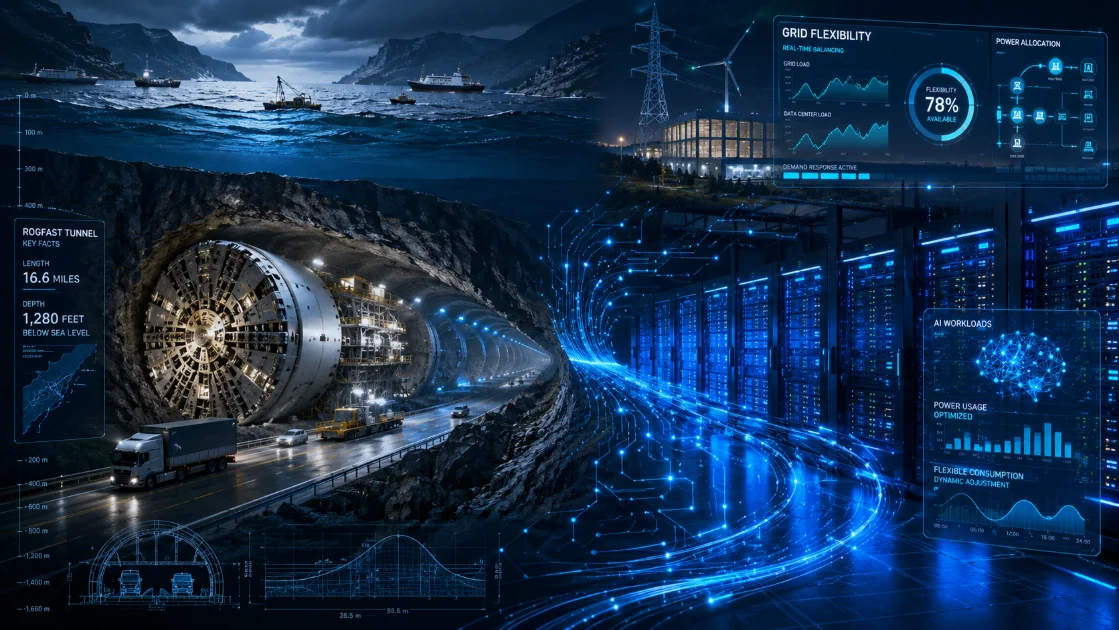
Norway is nearing completion on the Rogfast tunnel, set to become the world’s longest and deepest subsea road tunnel, an engineering marvel stretching 16.6 miles and descending 1,280 feet beneath the North Sea. This ambitious infrastructure project highlights humanity’s continued capacity for large-scale construction in an era where such feats often seem challenging to achieve. Simultaneously, the burgeoning AI sector is driving unprecedented demand for data centers, pushing grid operators and technology companies to explore flexible power solutions that can adapt to fluctuating energy needs without requiring extensive new power plant construction.
Key Developments
- The Rogfast tunnel in Norway will soon be the world’s longest and deepest subsea road tunnel, extending 16.6 miles and reaching a depth of 1,280 feet.
- This massive infrastructure project demonstrates the ongoing potential for ambitious engineering feats despite contemporary challenges.
- The increasing power demands of AI data centers are straining existing electrical grids.
- Flexible data center operations, which limit power draw during peak times, are emerging as a solution to reduce reliance on new power infrastructure.
- New software solutions are enhancing the precision and speed of grid flexibility for the AI era.
What Happened
Engineers are currently constructing Norway’s Rogfast tunnel, an extraordinary infrastructure project that will connect the country’s iconic fjords by road, plunging deep beneath the North Sea. This undertaking involves creating a 16.6-mile highway at depths reaching 1,280 feet, navigating immense water pressure and challenging geological conditions. The project underscores a commitment to large-scale engineering, proving that complex, impactful constructions are still achievable globally.
Concurrently, the rapid expansion of artificial intelligence applications is placing significant strain on global electrical grids. Traditional responses to increased power demand, such as building new power plants, are often slow and resource-intensive. Instead, the tech industry is looking towards grid flexibility, where data centers can dynamically adjust their power consumption. This approach aims to reduce the need for immediate, large-scale grid upgrades or independent off-grid power generation for AI infrastructure.
Why It Matters
The construction of the Rogfast tunnel signifies more than just a new transportation route; it represents a testament to human ingenuity and the enduring capability for grand engineering projects. In an age often characterized by complexity and regulatory hurdles, its progress reassures that ambitious physical infrastructure can still be realized. This project also sets a new benchmark for subsea tunnel construction, potentially influencing future designs globally.
Meanwhile, the push for flexible data centers directly addresses one of the most pressing challenges of the AI boom: sustainable power. By allowing data centers to modulate their energy usage, particularly during periods of high grid demand, it mitigates the need for costly and time-consuming new power plant construction. This approach offers a more agile and efficient way to integrate the escalating energy requirements of AI into existing power grids, fostering innovation in energy management software.
Industry Impact
The engineering advancements seen in the Rogfast tunnel will undoubtedly influence civil engineering and construction firms worldwide, particularly those involved in challenging underwater projects. The techniques and technologies developed for this tunnel could be adopted for future infrastructure initiatives in complex environments, potentially shortening project timelines and improving safety standards. It also highlights the continued demand for skilled labor and specialized equipment in large-scale infrastructure development.
For the technology and energy sectors, the focus on flexible data centers is poised to reshape how AI infrastructure is powered and deployed. This shift will likely spur significant investment and innovation in energy management software, smart grid technologies, and demand-response systems. Companies that can offer efficient, flexible power solutions will gain a competitive edge in supporting the AI industry, impacting data center design, location strategies, and operational protocols across the board. The need for memory chips to power AI is also set to drive up device prices, as SK Hynix has recently surpassed Samsung as the world’s most valuable memory chipmaker, benefiting significantly from this AI-driven demand.
Analysis
The parallel narratives of the Rogfast tunnel and flexible data centers, while distinct in their immediate fields, both speak to a broader theme of adaptation and innovation in the face of significant challenges. The tunnel’s construction exemplifies overcoming physical barriers through sheer engineering will and long-term planning. It serves as a powerful reminder that monumental human achievements are still within reach, even when they involve navigating immense natural pressures and logistical complexities.
In the digital realm, the pressure exerted by AI’s energy demands is leading to an equally critical, albeit less visible, engineering evolution. The concept of a flexible grid, optimized by advanced software, represents a strategic pivot from simply increasing supply to intelligently managing demand. This paradigm shift acknowledges the limitations of rapid infrastructure expansion and instead prioritizes efficiency and responsiveness, paving the way for a more resilient and adaptable energy system capable of supporting future technological growth.
Future Implications
- Near-term (3–6 months): Completion of the Rogfast tunnel will provide valuable data and case studies for future subsea infrastructure projects, potentially accelerating planning for similar ventures globally.
- Medium-term (1–2 years): Increased adoption of flexible data center power management solutions will become standard practice, leading to significant advancements in grid integration software and energy storage technologies.
- Long-term (3–5 years): The success of demand-side management in data centers could inspire broader implementation of flexible energy consumption models across other industrial sectors, contributing to more stable and sustainable national grids.
Actionable Insights
- Civil engineering firms should study the Rogfast project’s methodologies for deep and long subsea tunnel construction to inform future bids and designs.
- Data center operators should invest in advanced software solutions for flexible power management to optimize energy consumption and reduce operational costs.
- Energy providers should collaborate with tech companies to develop smarter grid infrastructure capable of dynamic load balancing for AI and other high-demand sectors.
- Policymakers should consider incentives for data centers to adopt flexible energy practices, encouraging sustainable growth of AI infrastructure.
What is the Rogfast tunnel?
The Rogfast tunnel is an ambitious subsea road tunnel under construction in Norway, set to become the world’s longest and deepest. It will span 16.6 miles and descend to a depth of 1,280 feet beneath the North Sea.
Why are flexible data centers important for AI?
Flexible data centers are crucial for the AI boom because they can limit their power draw during periods of high demand on the electrical grid. This reduces the need for immediate, costly, and time-consuming construction of new power plants or infrastructure upgrades to support AI’s growing energy needs.
How does flexibility benefit the electric grid?
Grid flexibility, particularly from data centers, allows for more efficient management of existing power infrastructure. By reducing demand during peak times, it prevents strain on the grid, delays the need for major infrastructure investments, and contributes to a smarter, more resilient energy system.
Key Takeaways
- Norway’s Rogfast tunnel represents a significant achievement in modern engineering, setting records for subsea tunnel length and depth.
- The project underscores the continued feasibility of large-scale infrastructure development despite complex challenges.
- The AI industry’s escalating power requirements are driving innovation in flexible data center operations and smart grid technologies.
- Software advancements are making grid flexibility more precise and efficient for managing AI’s energy demands.