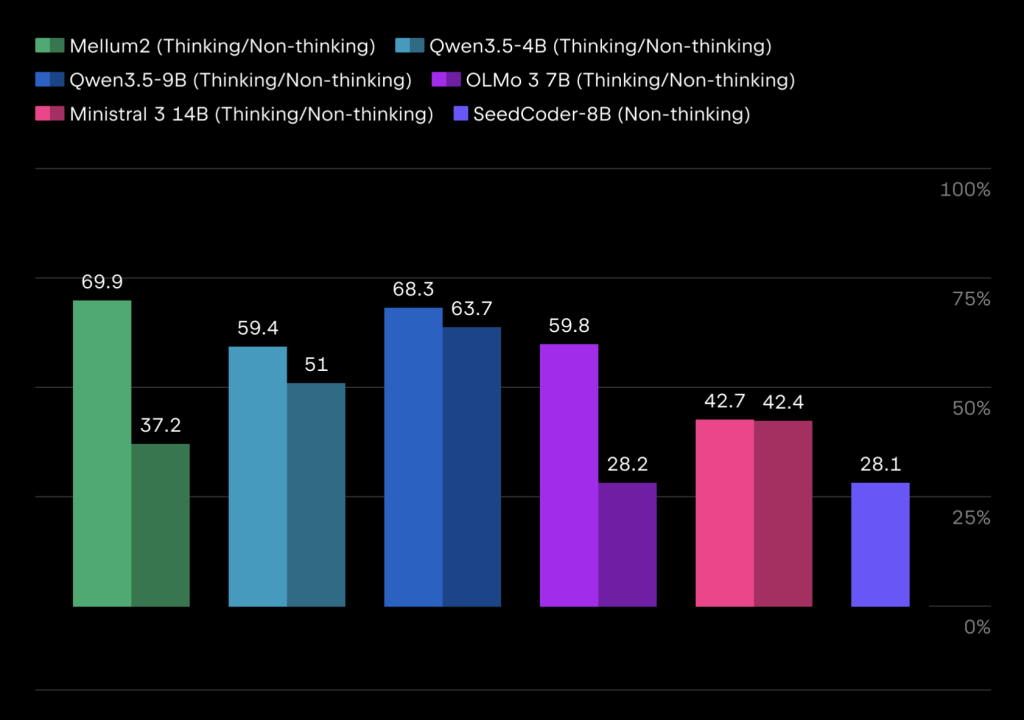
JetBrains has officially unveiled Mellum2, an advanced 12-billion parameter Mixture-of-Experts (MoE) model specifically engineered for fast, specialized tasks within complex multi-model AI pipelines. This release, with its weights now open-sourced under the Apache 2.0 license, marks a significant evolution from its predecessor, the 4B dense model Mellum. Mellum2 focuses on software engineering applications, offering capabilities in code generation, debugging, and multi-step reasoning, positioning itself not as a general-purpose frontier model replacement but as a highly efficient component for larger AI systems. This strategic specialization addresses the growing industry demand for AI models that can excel in niche domains without the computational overhead of monolithic generalist architectures.
Key Developments
- JetBrains released Mellum2, a 12-billion parameter Mixture-of-Experts (MoE) model, making its weights available under the Apache 2.0 license.
- Mellum2 is engineered as a general-purpose model with a specialized focus on software engineering tasks, including code generation, debugging, and agentic coding.
- The model employs an MoE architecture with 64 experts, activating 8 per token, resulting in 2.5 billion active parameters per token while maintaining a 12 billion total parameter count.
- JetBrains positions Mellum2 as a “focal model,” designed to serve as a fast, specialized component within broader AI systems rather than a standalone replacement for larger, generalist models.
- This release follows the initial Mellum model, a completion-focused 4B dense architecture, indicating a strategic shift towards specialized MoE designs for specific industry applications.
What Happened
JetBrains, a prominent developer of integrated development environments and software tools, recently announced the public release of Mellum2, an innovative AI model tailored for software engineering. This new model represents a substantial upgrade from the original Mellum, which was a 4-billion parameter dense model primarily focused on code completion tasks. Mellum2, in contrast, is a more versatile and specialized AI, encompassing a broader range of software development activities, from intricate code generation and editing to sophisticated debugging and conversational programming assistance.
The company has made the weights for Mellum2 openly accessible under the Apache 2.0 license, a move that encourages broader adoption and collaborative development within the AI community. Architecturally, Mellum2 utilizes a Mixture-of-Experts (MoE) design, featuring a total of 12 billion parameters. Critically, only 2.5 billion parameters are actively engaged per token during inference, achieved by activating 8 out of its 64 specialized experts. This design choice allows Mellum2 to deliver high performance for its target domain while maintaining computational efficiency comparable to a much smaller dense model.
JetBrains explicitly frames Mellum2 as a “focal model,” emphasizing its role as a specialized, high-speed component designed to integrate into larger, multi-model AI workflows. This strategic positioning suggests an industry trend towards modular AI systems where specialized models handle specific tasks, optimizing overall system performance and resource utilization. The model’s capabilities extend to multi-step reasoning, effective tool use, function calling, and agentic coding, making it a comprehensive assistant for software developers.
Why It Matters
The introduction of JetBrains’ Mellum2 signals a crucial evolution in the application of AI within the software development lifecycle, holding significant implications for businesses, individual developers, and the competitive landscape. By open-sourcing a specialized MoE model focused on software engineering, JetBrains is not only contributing to the open AI ecosystem but also setting a precedent for how domain-specific AI can be developed and deployed. This approach directly addresses the limitations of monolithic general-purpose models, which often struggle with the nuanced demands of highly technical fields like software development.
For businesses, Mellum2 offers the potential for substantial gains in developer productivity and code quality. Integrating such a specialized model into existing development pipelines can automate repetitive coding tasks, assist with complex debugging, and accelerate the entire software creation process. This could translate into faster product cycles, reduced development costs, and an enhanced ability to innovate. The open-source nature further lowers the barrier to entry, allowing companies of all sizes to experiment with and deploy advanced AI capabilities without proprietary vendor lock-in.
The competitive dynamics within the AI and software tools sectors are also impacted. As major players like JetBrains invest in specialized AI, it pushes other companies to consider similar strategies, potentially leading to a fragmentation of the AI model market into specialized niches. This benefits users by providing more tailored and efficient tools, but it also creates a challenge for developers to navigate an increasingly diverse landscape of AI models. Mellum2’s focus on being a “focal model” highlights a shift towards composable AI systems, where different specialized models collaborate to achieve complex outcomes, moving away from the single-model dominance narrative.
Industry Impact
Mellum2’s release has tangible implications across the broader AI and technology ecosystem, particularly within industries heavily reliant on software development. The model’s specialization in software engineering tasks, coupled with its efficient MoE architecture, offers a blueprint for how AI can be effectively integrated into highly technical domains. This moves beyond generic language understanding to targeted problem-solving, impacting a wide array of users from individual developers to large enterprise software teams.
In the software development industry itself, Mellum2 can significantly alter workflows. Developers can expect more intelligent code completion, sophisticated error detection, and even autonomous code generation for routine functions, freeing up their time for more complex architectural design and problem-solving. Companies like Microsoft (with GitHub Copilot) and Google (with Codey models) are already active in this space, and Mellum2’s open-source nature provides an alternative that can be fine-tuned and deployed on-premises, appealing to organizations with strict data privacy or customization requirements.
Beyond traditional software companies, sectors like finance, healthcare, and manufacturing, which increasingly rely on custom software solutions, stand to benefit. The ability to accelerate the development of specialized applications, ensure higher code quality, and reduce debugging cycles can directly impact time-to-market for new digital products and services. For example, a financial institution developing a new trading algorithm could use Mellum2 for rapid prototyping and error checking, while a healthcare provider building a patient management system could leverage it for secure and compliant code generation. The model’s capacity for multi-step reasoning and agentic coding also opens avenues for creating more autonomous development agents, pushing the boundaries of what AI can achieve in collaborative coding environments.
Expert Analysis
The strategic positioning of Mellum2 as a “focal model” for specialized tasks within larger AI pipelines represents a maturing perspective on AI deployment. Rather than pursuing the often elusive goal of a single, all-encompassing artificial general intelligence, JetBrains is demonstrating the practical value of highly optimized, domain-specific models. This approach acknowledges that different tasks within a complex system benefit from different types of intelligence and computational trade-offs. The MoE architecture is particularly well-suited for this, allowing the model to have a vast knowledge capacity while only activating the relevant parts for a given query, making it efficient for specific software engineering challenges.
This move is not just a technical achievement but also a significant market signal. It suggests that the future of enterprise AI may not be dominated by a few massive, proprietary foundation models, but rather by an ecosystem of specialized, interoperable components. Open-sourcing Mellum2 under Apache 2.0 further democratizes access to advanced AI capabilities for software development, potentially fostering a vibrant community around its use and improvement. This could lead to a proliferation of customized versions of Mellum2, tailored for specific programming languages, frameworks, or even company-specific coding standards, thereby extending its utility far beyond its initial release.
Competitive Landscape
The release of Mellum2 by JetBrains enters a competitive landscape already populated by significant players in AI-assisted software development. Major technology companies have been actively developing and integrating AI into their developer tools for some time. OpenAI, through its partnership with Microsoft, powers GitHub Copilot, a widely adopted AI coding assistant that leverages models like Codex and, more recently, GPT-4 for code generation and completion. Google has introduced its Codey models, specifically designed for coding tasks within its Vertex AI platform, and has integrated AI capabilities into tools like Firebase and Google Cloud’s developer services.
Beyond these giants, numerous startups and smaller firms are also innovating in the AI coding space, offering specialized tools for specific languages, testing, or security analysis. Mellum2 differentiates itself through its explicit MoE architecture, which promises efficiency for specialized tasks, and its open-source license, providing an alternative to proprietary offerings. While GitHub Copilot and Google’s Codey are often integrated into broader development ecosystems, Mellum2’s open-source nature allows for greater flexibility in deployment and customization, potentially appealing to organizations that prioritize control over their AI infrastructure or have unique compliance requirements. This creates a fascinating dynamic where proprietary, deeply integrated solutions compete with flexible, open-source alternatives, driving innovation across the board.
Future Implications
In the near-term (3-6 months), Mellum2’s open-source availability will likely lead to rapid community engagement. Developers will begin experimenting with fine-tuning the model for specific programming languages, frameworks, and niche tasks, potentially generating a wave of custom Mellum2 derivatives. Expect to see early integrations into various IDEs and CI/CD pipelines, showcasing its utility as a specialized component.
Medium-term (1-2 years), the success of Mellum2 could catalyze a broader industry trend towards “focal models” for other specialized domains beyond software engineering. We may see similar MoE architectures emerge for legal document analysis, scientific research, or specific industrial design tasks, each optimized for its unique data and computational patterns. This period will also likely see JetBrains further refining Mellum2, potentially adding more experts or expanding its training data to cover an even wider array of software engineering challenges.
Long-term (3-5 years), Mellum2 and similar specialized MoE models could fundamentally reshape how large-scale AI systems are architected. Instead of relying solely on massive, general-purpose models, AI systems might become highly modular, orchestrating dozens or hundreds of specialized “focal models” to achieve complex, multi-modal tasks. This could lead to more efficient, scalable, and adaptable AI, capable of tackling highly specific problems with precision, while also fostering a more diverse and competitive AI model ecosystem.
Actionable Insights
- Evaluate Mellum2 for Specialized Software Tasks: Developers and engineering leaders should download and experiment with Mellum2, particularly for code generation, debugging, and multi-step reasoning within software engineering projects, to assess its performance against existing tools.
- Explore MoE Architecture for Custom AI: Organizations with unique domain-specific AI needs should study Mellum2’s Mixture-of-Experts (MoE) architecture as a blueprint for building efficient, specialized models that balance capacity and computational cost.
- Integrate into Existing Development Pipelines: Investigate how Mellum2 can be integrated into current IDEs, code review processes, or CI/CD workflows to automate tasks and enhance developer productivity, leveraging its open-source nature for customization.
- Contribute to the Open-Source Community: Engage with the Mellum2 open-source project by contributing code, providing feedback, or developing extensions, helping to shape its future development and expand its capabilities.
- Strategize for Multi-Model AI Systems: Begin planning for a future where AI solutions are composed of multiple specialized models rather than a single generalist one, identifying areas where “focal models” can optimize specific business processes.
- Assess License for Commercial Use: Understand the implications of the Apache 2.0 license for commercial deployment and potential modifications, ensuring compliance and maximizing the benefits of open-source flexibility.
What is JetBrains Mellum2?
JetBrains Mellum2 is a 12-billion parameter Mixture-of-Experts (MoE) AI model specifically designed for software engineering tasks. It focuses on capabilities like code generation, debugging, and multi-step reasoning, operating as a fast, specialized component within larger AI systems.
Is Mellum2 open source?
Yes, JetBrains has released Mellum2 with its weights open-sourced under the Apache 2.0 license. This allows developers and organizations to freely use, modify, and distribute the model for various applications.
How does Mellum2’s MoE architecture work?
Mellum2 employs a Mixture-of-Experts (MoE) architecture with 64 total experts. For each token processed, only 8 experts are activated, meaning only 2.5 billion of its 12 billion parameters are active, making it computationally efficient while retaining high capacity.
What kind of tasks can Mellum2 perform?
Mellum2 is specialized for a range of software engineering tasks, including code generation and editing, debugging, multi-step reasoning, tool use, function calling, agentic coding, and conversational programming assistance.
How does Mellum2 compare to frontier models like GPT-4?
JetBrains positions Mellum2 as a “focal model,” meaning it is a specialized component for specific tasks rather than a standalone replacement for general-purpose frontier models like GPT-4. It aims for efficiency and precision in its niche, not broad general intelligence.
Key Takeaways
- JetBrains released Mellum2, a 12B MoE model, open-sourcing its weights under the Apache 2.0 license.
- Mellum2 is a specialized AI model for software engineering, covering code generation, debugging, and multi-step reasoning.
- Its Mixture-of-Experts architecture activates 2.5 billion parameters per token from a total of 12 billion, ensuring efficiency.
- The model is designed as a “focal component” for multi-model AI pipelines, not a standalone replacement for frontier models.
- This release signals a growing industry trend towards specialized, efficient AI models for domain-specific tasks in enterprise applications.