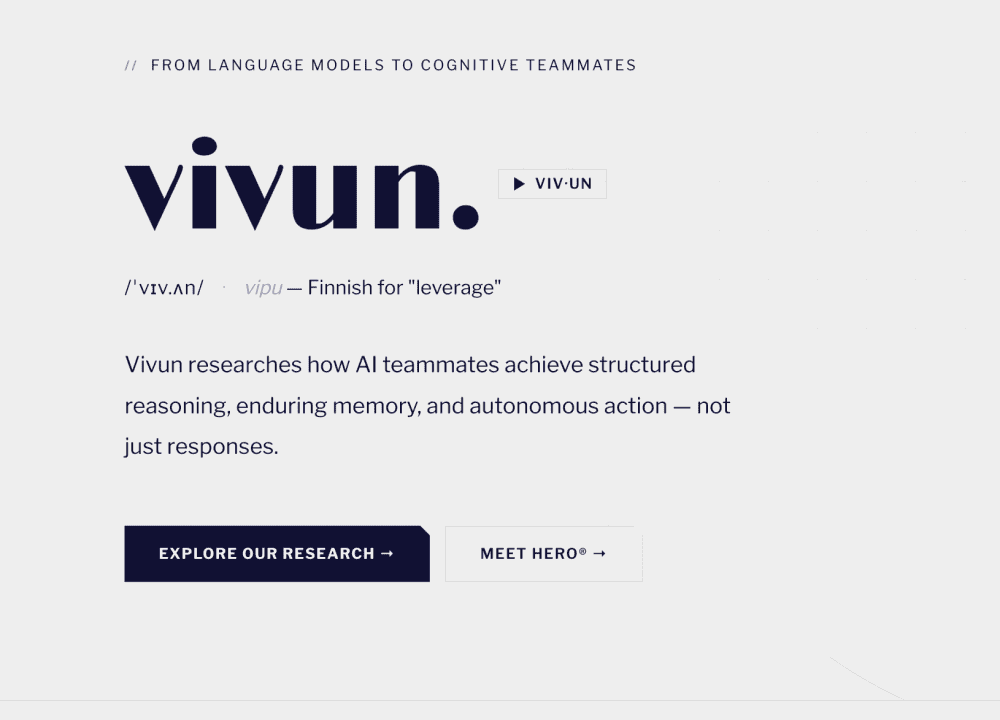
Vivun’s recent demonstration at SaaStr AI highlighted a critical shift in AI application, where a single, sophisticated AI teammate outperformed a collection of 20 disparate AI sales agents. Jarod Greene, CMO of Vivun, presented compelling evidence that the prevailing strategy of deploying multiple specialized AI agents across the sales cycle introduces significant inefficiencies and fragmentation. This fragmented approach, often influenced by industry recommendations, is now revealing its costs in the most critical sales interactions. The core issue lies in the live sales call, where context loss and execution delays directly impact deal velocity and customer experience, making this a pivotal moment for go-to-market teams to reassess their AI strategies.
Key Developments
- Vivun demonstrated that a single, integrated AI teammate can deliver superior results compared to a multi-agent AI architecture in sales.
- The prevalent industry practice involves deploying 15 to 20 specialized AI agents within a single sales organization, often leading to performance degradation.
- Fragmentation caused by numerous AI agent handoffs results in significant context loss and slows down critical sales processes.
- The negative impact of this multi-agent strategy is most pronounced during live sales calls, affecting a sales representative’s ability to respond effectively.
- Jarod Greene, CMO of Vivun, presented these findings at SaaStr AI, challenging the conventional wisdom in AI sales deployments.
What Happened
Industry go-to-market teams have, over the past 18 months, heavily invested in a modular AI strategy, acquiring individual agents for distinct tasks within the sales pipeline. This approach, widely adopted and often influenced by analyst recommendations, led companies to evaluate and implement separate AI agents for specific functions: one for lead qualification, another for scheduling, a third for content generation, and so on. Jarod Greene, CMO of Vivun, reported that it is now common to encounter sales organizations attempting to manage and integrate between 15 and 20 such agents simultaneously. This complex web of interconnected, yet often siloed, AI tools was the subject of Greene’s presentation at SaaStr AI.
Greene’s talk specifically addressed the detrimental consequences of this “pile of agents” on the sales process, particularly its direct impact on deal progression and cost. He detailed how the fragmentation inherent in this multi-agent architecture imposes a significant “fragmentation tax.” This tax manifests most acutely during live sales interactions. Every handoff between different AI agents results in a loss of critical context, introducing delays and diminishing the overall speed of execution—a factor Greene emphasized as paramount in modern sales. The most glaring breakdown occurs when a sales representative faces a complex or challenging question during a live call, and the fragmented AI support system fails to provide timely, coherent assistance.
Vivun’s counter-demonstration showcased an integrated AI teammate capable of handling diverse sales functions holistically. This single AI entity, designed to maintain continuous context across all interactions, proved more effective than the distributed network of specialized agents. The core message was clear: while individual agents might perform their specific tasks adequately, the cumulative effect of their integration and handoffs often negates their individual benefits, leading to a less efficient and more costly overall sales operation. The experiment underscored a growing realization that more AI agents do not necessarily equate to better AI performance.
Why It Matters
This development is significant because it challenges a fundamental assumption that has guided enterprise AI adoption in sales for nearly two years: the belief that specialization equals optimization. Companies have invested heavily in a distributed AI architecture, only to discover that the aggregate effect can be counterproductive. The “fragmentation tax” described by Vivun’s CMO, Jarod Greene, directly impacts revenue generation by slowing down deal cycles and reducing conversion rates on crucial live calls. This is not merely a technical inefficiency; it is a direct business cost that erodes profit margins and diminishes competitive agility.
For sales organizations, the implications are immediate. The ability of a sales rep to respond accurately and swiftly during a live customer interaction is paramount. When supporting AI systems introduce delays or lose context across handoffs, it directly undermines the rep’s effectiveness, potentially leading to lost deals and damaged customer relationships. This insight compels businesses to reconsider their entire AI strategy, moving away from a purely task-oriented agent deployment towards more integrated, context-aware AI solutions. It highlights that the true value of AI in sales lies not just in automating tasks, but in enhancing the human sales experience without introducing friction.
Industry Impact
The implications of Vivun’s findings ripple across the entire AI and SaaS industries, particularly for companies developing and deploying sales enablement tools. The current market, flush with specialized AI agents for every conceivable sales function—from lead scoring and prospecting to meeting summarization and follow-up generation—may face a significant recalibration. Vendors previously focused on niche AI solutions might need to pivot towards more integrated platforms or develop robust interoperability features that genuinely preserve context across different modules. This could lead to a wave of consolidation or strategic partnerships among AI solution providers.
Beyond sales tech, this shift influences broader enterprise AI strategies. It reinforces the growing understanding that deploying AI is not just about functionality, but about orchestration and user experience. Industries heavily reliant on complex, multi-stage customer interactions, such as financial services, healthcare, and high-tech manufacturing, will take note. These sectors often face similar challenges with fragmented digital tools and handoffs, and the lesson from sales—that a unified AI experience can outperform a collection of specialized agents—is directly transferable. The emphasis will move from simply automating individual steps to creating an intelligent, cohesive workflow that supports human operators effectively.
Expert Analysis
The Vivun demonstration serves as a stark reminder that the pursuit of AI efficiency must prioritize holistic system design over mere task automation. The industry’s initial rush to segment sales processes and assign an individual AI agent to each segment, while seemingly logical on paper, overlooked the critical human element and the inherent need for continuous context in dynamic interactions. This “agent for every job” mentality, often driven by a desire for granular control and measurable KPIs for each AI component, paradoxically introduces systemic friction that negates many of the intended benefits.
The core issue is not the capability of individual AI agents, but the cost of their integration and the degradation of information across handoffs. Each transition point between agents acts as a potential bottleneck and a site of data loss. In a live sales call, where responsiveness and deep understanding of the customer’s immediate needs are paramount, these micro-delays and context gaps accumulate to a significant disadvantage. The single AI teammate approach, by contrast, suggests a move towards a more sophisticated, stateful AI architecture that maintains a persistent understanding of the interaction history and customer profile, enabling genuinely intelligent and timely support.
Competitive Landscape
The competitive landscape within the AI sales enablement sector is poised for a significant shift in light of Vivun’s insights. Companies that have heavily invested in developing or acquiring a suite of narrowly focused AI agents may find their offerings less compelling if the market pivots towards integrated solutions. This could pressure smaller, single-feature AI vendors to either merge with larger platforms or rapidly expand their capabilities to offer more comprehensive, context-aware services. Larger players, particularly those with existing CRM or sales automation platforms, are better positioned to integrate AI functionalities natively, presenting a more unified “AI teammate” experience.
This development also puts a spotlight on the underlying AI models and architectures. Companies leveraging foundational models and developing sophisticated orchestration layers will gain a significant advantage. The ability to maintain state, learn from continuous interactions, and dynamically adapt across various sales scenarios within a single AI entity will become a key differentiator. Expect to see increased R&D in areas like multi-modal context understanding, long-context window processing, and more robust agentic AI frameworks that can manage complex workflows without external handoffs. This could lead to a wave of acquisitions focused on integrating these advanced AI capabilities into existing enterprise software suites.
Future Implications
Near-term (3-6 months): Sales organizations will likely initiate internal audits of their existing AI agent stacks, assessing the true cost of fragmentation versus the benefits of individual agents. Expect a slowdown in the procurement of new, narrowly specialized AI tools, with a preference for platforms demonstrating integration capabilities. AI vendors will begin to heavily market “unified AI” or “intelligent assistant” solutions, emphasizing context preservation.
Medium-term (1-2 years): The market will see a significant shift towards consolidation among AI sales tool providers. Companies offering single-function agents will either be acquired by larger platforms seeking to integrate their capabilities or will be forced to expand their offerings to encompass a broader range of context-aware functions. Enterprise software giants will accelerate the embedding of advanced, integrated AI capabilities directly into their core CRM and ERP systems, making standalone agents less necessary.
Long-term (3-5 years): The concept of a “sales AI teammate” will evolve into a standard feature of enterprise software, deeply integrated into daily workflows. Specialized AI agents, if they exist, will function as modular components within a larger, intelligent orchestration layer, rather than standalone tools requiring complex manual stitching. The focus will be on predictive and prescriptive AI that not only supports but actively guides sales professionals through complex deal cycles with continuous, context-rich intelligence, fundamentally reshaping the role of the human sales representative.
Actionable Insights
- Conduct a comprehensive audit of your current AI agent stack to identify points of fragmentation and context loss.
- Prioritize AI solutions that demonstrate strong integration capabilities and a focus on maintaining continuous context across sales workflows.
- Evaluate the total cost of ownership (TCO) for multi-agent systems, factoring in the “fragmentation tax” of lost context and execution delays.
- Invest in training sales teams to effectively utilize more integrated AI tools, focusing on how a single AI teammate can enhance, rather than complicate, their workflow.
- Engage with AI vendors who are actively developing or offering holistic, intelligent assistant-style solutions rather than just discrete task-based agents.
- Develop an internal roadmap for AI adoption that emphasizes strategic integration and contextual intelligence over a piecemeal approach to automation.
What is the “fragmentation tax” in AI sales?
The “fragmentation tax” refers to the hidden costs incurred when sales organizations deploy numerous disparate AI agents for different tasks. These costs arise from context loss, handoff delays, and reduced execution speed, particularly impacting critical live sales calls.
Why did companies adopt multiple AI sales agents?
Many companies adopted multiple AI sales agents based on industry recommendations and the perceived benefit of specializing AI for discrete parts of the sales cycle. The idea was to optimize each task with a dedicated AI, leading to a “task, an agent” approach.
How does a single AI teammate outperform multiple agents?
A single, integrated AI teammate outperforms multiple agents by maintaining continuous context across all interactions. This eliminates the loss of information and delays that occur during handoffs between separate agents, leading to faster, more coherent, and more effective support during sales processes.
What are the main consequences of AI fragmentation in sales?
The main consequences include slower deal cycles, reduced sales conversion rates, diminished responsiveness during live customer interactions, and increased operational costs due to the complexity of managing and integrating numerous disparate AI tools.
What should sales leaders consider when implementing AI now?
Sales leaders should prioritize integrated AI solutions that offer holistic support and maintain continuous context, rather than buying individual agents for every task. They should also evaluate the long-term strategic benefits of a unified AI approach over short-term task automation.
Key Takeaways
- A single, integrated AI teammate can significantly outperform a stack of 20 specialized AI sales agents by preserving context.
- The prevalent strategy of deploying numerous discrete AI agents in sales organizations creates a “fragmentation tax” through context loss and execution delays.
- The negative impact of fragmented AI systems is most acutely felt during live sales calls, hindering representative effectiveness.
- Industry go-to-market teams are now re-evaluating their AI strategies, shifting from task-specific agents to more holistic, context-aware solutions.
- This development signals a crucial shift towards unified AI architectures in enterprise sales, prioritizing seamless workflows over segmented automation.