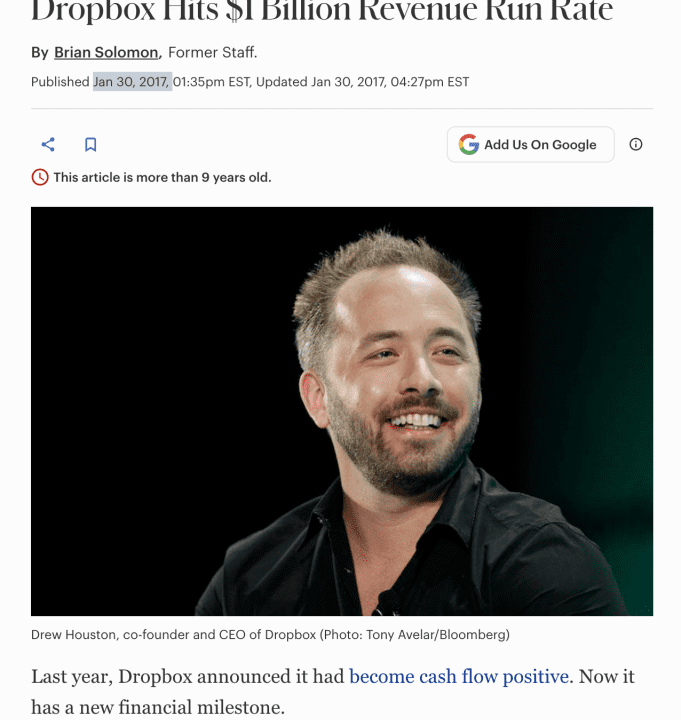
Dropbox, under the leadership of co-founder Drew Houston, achieved an unprecedented milestone, reaching $1 billionAnnual Recurring Revenue (ARR) faster than any B2B company before it. This remarkable ascent, fueled by a near-perfect Product-Led Growth (PLG) strategy and minimal capital burn, solidified its status as a SaaS industry darling for nearly two decades. However, after 19 years at the helm, Houston is transitioning to the Executive Chairman role, marking a significant leadership shift. This transition, with Ashraf Alkarmi stepping in as co-CEO and eventual sole CEO, signals a critical juncture for a company that, despite its initial meteoric rise, has struggled to find a substantial “second act” in an increasingly competitive and AI-driven market.
The Era of Dropbox’s Unrivaled PLG Dominance
For a generation of SaaS founders and executives, Dropbox represented the pinnacle of B2B growth and efficiency. Its model of organic user acquisition, viral loops, and a free-to-paid conversion funnel was revolutionary, allowing it to scale to immense proportions without the heavy sales and marketing investments typically associated with enterprise software. This lean yet potent approach allowed the company to achieve its $1 billionARR landmark at a speed that remains unmatched in the B2B sector.
The company’s early success was largely attributable to its singular focus on solving a clear, everyday problem: cloud storage and file synchronization. By making a complex technical challenge accessible and intuitive for millions of users, Dropbox carved out a massive market share. Its product was so sticky and ubiquitous that it became a verb, a testament to its deep integration into the workflows of individuals and small teams globally.
Drew Houston’s Enduring Legacy and Leadership Transition
Drew Houston’s nearly two-decade tenure as CEO is an extraordinary feat in the fast-paced tech world. His vision propelled Dropbox from a simple idea to a global enterprise, defining an era of cloud computing and collaborative work. Houston’s ability to navigate hyper-growth, an IPO, and the relentless evolution of the tech landscape speaks volumes about his leadership prowess and strategic foresight.
His move to Executive Chairman is not just a change in title; it signifies a deliberate shift in the company’s operational command. This transition allows Houston to maintain strategic oversight while empowering new leadership to drive the company’s future direction. It’s a classic move for founders looking to ensure long-term stability and inject fresh perspectives into mature organizations.
Ashraf Alkarmi’s Ascent: A New Chapter for Core Products
Ashraf Alkarmi, who joined Dropbox in November 2024 as GM of Core after serving as CPO at Vimeo, is now stepping into the co-CEO role. This appointment positions Alkarmi as the eventual sole CEO, marking a pivotal moment for Dropbox’s executive leadership. His background in product leadership, particularly at a company focused on creative professionals, suggests a potential renewed emphasis on core product innovation and user experience.
Alkarmi’s mandate will likely involve reinvigorating Dropbox’s flagship offerings and exploring new avenues for growth. The challenge will be to evolve the core product beyond its established functionalities, especially as the competitive landscape intensifies and user expectations shift. His experience in driving product strategy could be crucial in charting this new course.
The Search for a “Second Act” in a Crowded Market
Despite its initial explosive growth, Dropbox has faced the perennial challenge of many successful tech companies: finding a compelling “second act.” While it mastered the art of cloud storage, the market has become saturated with formidable competitors, including tech giants offering integrated suites of tools. This commoditization has made it difficult for Dropbox to differentiate significantly beyond its core offering.
The company has made efforts to expand into areas like document collaboration and e-signature, but these ventures have not achieved the same breakout success as its initial product. The narrative around Dropbox often highlights its incredible start, but also the subsequent struggle to replicate that disruptive innovation. This search for new growth engines is a critical item on the new leadership’s agenda.
Navigating the AI Era Without a Clear AI Strategy (Yet)
One of the most pressing challenges for Dropbox, and indeed for any legacy tech company, is the integration and strategic leveraging of artificial intelligence. The background context explicitly notes that a “second act” was elusive even pre-AI, suggesting that the company may be playing catch-up in the current generative AI boom. Competitors are rapidly embedding AI into their productivity suites, offering intelligent search, content generation, and automated workflows.
For Dropbox to remain relevant and competitive, it must articulate and execute a robust AI strategy that goes beyond incremental features. This could involve AI-powered file organization, intelligent content recommendations, or even deeper integrations with generative AI tools to enhance document creation and collaboration. The new leadership will need to demonstrate how Dropbox can harness AI to redefine its value proposition for the modern professional.
The Future of B2B SaaS: Beyond Storage to Intelligence
The B2B SaaS landscape is rapidly shifting from foundational infrastructure to intelligent, proactive solutions. Companies are no longer just looking for tools that store data; they seek platforms that can analyze, interpret, and act on that data to improve productivity and decision-making. This evolution presents both a threat and an opportunity for Dropbox.
To thrive, Dropbox must evolve its identity from a cloud storage provider to an intelligent workspace platform. This would involve leveraging its vast dataset of user files to offer predictive insights, automate routine tasks, and facilitate smarter collaboration. The leadership transition provides a fresh opportunity to recalibrate this strategic direction and ensure Dropbox remains a vital component of the modern enterprise toolkit.
Who is the new CEO of Dropbox?
Ashraf Alkarmi, who previously served as GM of Core at Dropbox and CPO at Vimeo, has been appointed co-CEO. He is slated to eventually become the sole CEO, succeeding co-founder Drew Houston.
How fast did Dropbox reach $1 billion in ARR?
Dropbox achieved $1 billion in Annual Recurring Revenue (ARR) faster than any other B2B company in history. This rapid growth was largely attributed to its successful product-led growth (PLG) strategy.
What is Drew Houston’s new role at Dropbox?
After 19 years as CEO, Drew Houston is transitioning to the Executive Chairman role. In this capacity, he will continue to provide strategic guidance and oversight for the company.
Key Takeaways
- Drew Houston is transitioning from CEO to Executive Chairman after 19 years at the helm of Dropbox.
- Ashraf Alkarmi, formerly GM of Core, has been appointed co-CEO and is expected to become the sole CEO.
- Dropbox achieved $1 billion in Annual Recurring Revenue (ARR) faster than any B2B company, largely due to its successful product-led growth model.
- The company faces the challenge of finding a significant “second act” and integrating AI strategically to remain competitive in the evolving SaaS market.