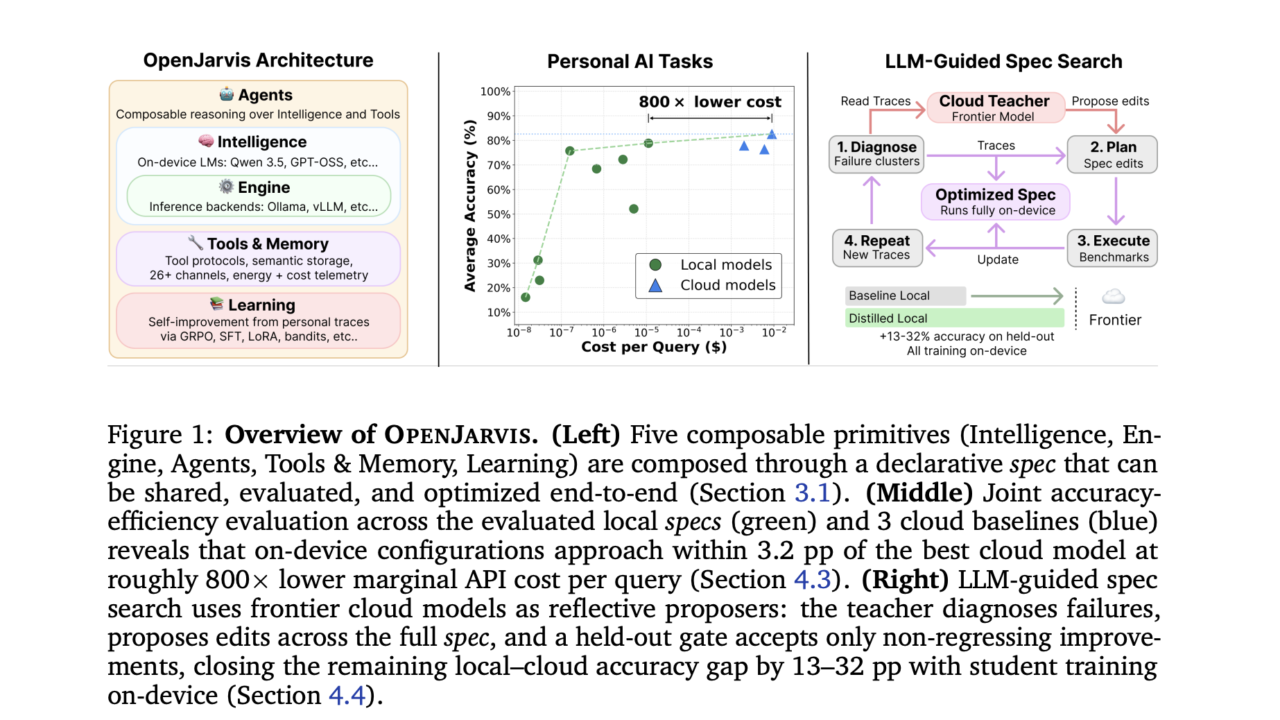
Stanford University researchers, in collaboration with Lambda Labs, have unveiled OpenJarvis, an open-source framework designed to bring sophisticated personal AI agents directly onto user devices. This new framework manages inference, agent logic, memory, and learning entirely locally, offering a significant shift from cloud-dependent AI models. OpenJarvis’s configured open-weight models achieve performance within 3.2 percentage points of leading cloud-based models on average, while dramatically reducing marginal API costs by approximately 800 times per query. This development directly addresses the growing demand for private, efficient, and accessible AI, making advanced AI capabilities more ubiquitous for everyday users.
Key Developments
- OpenJarvis is an open-source framework enabling personal AI agents to operate entirely on-device, handling inference, agent stack, memory, and learning.
- The framework utilizes open-weight models that perform within 3.2 percentage points of the best cloud models, demonstrating near-parity in intelligence.
- Marginal API costs per query are reduced by approximately 800 times, alongside a roughly 4 times lower latency under the research’s benchmark protocol compared to cloud alternatives.
- This research builds upon prior work indicating local models already manage 88.7% of single-turn chat and reasoning queries with interactive latency.
- The project was officially released on March 12, 2026, with its research paper posted on arXiv on May 16, 2026.
What Happened
Researchers from Stanford University and Lambda Labs officially published the details of OpenJarvis, an innovative open-source framework for on-device personal AI agents, on May 16, 2026, via arXiv. The framework itself was released to the public on March 12, 2026, under an Apache 2.0 license. This initiative aims to democratize access to advanced AI by shifting computational burdens from centralized cloud servers to local devices.
The core of OpenJarvis lies in its ability to compose various supported models with a configurable agent stack, which includes functionalities for tools, memory, and learning, all executed locally. The research evaluated this framework across 11 local models stemming from four distinct families, demonstrating its versatility and broad applicability. The project’s GitHub repository, found at github.com/open-jarvis/OpenJarvis, has already garnered significant attention, accumulating approximately 5.4 thousand stars and 1.2 thousand forks by June 2026, primarily featuring Python code.
This work extends the findings from the research team’s earlier “Intelligence Per Watt” study. That prior research highlighted the increasing efficiency of local models, reporting a 5.3 times improvement in intelligence efficiency between 2023 and 2025. It also noted that local models were already proficient at handling 88.7% of single-turn chat and reasoning queries with interactive latency, setting the stage for OpenJarvis’s capabilities.
Why It Matters
OpenJarvis represents a pivotal moment for the AI industry, shifting the paradigm from cloud-centric AI processing to a local-first approach. This change carries profound implications for data privacy, operational costs, and the accessibility of advanced AI. By enabling AI agents to run entirely on-device, users gain greater control over their data, as sensitive information no longer needs to be transmitted to external servers for processing.
For businesses, the framework offers a compelling alternative to expensive cloud API calls. The reported 800 times lower marginal API cost per query translates into substantial savings, particularly for applications requiring frequent AI interactions. Furthermore, the approximately 4 times lower latency under benchmark conditions means faster response times and a more fluid user experience, which is critical for real-time applications and personal assistants. This efficiency could spur the development of new classes of on-device AI applications that were previously cost-prohibitive or too slow.
Industry Impact
The introduction of OpenJarvis is set to significantly reshape various sectors within the broader AI and technology ecosystem. Industries reliant on rapid, private, and cost-effective AI inference stand to benefit immensely. For instance, in healthcare, on-device AI can process sensitive patient data without violating privacy regulations, enabling personalized diagnostics or treatment suggestions directly on medical devices. Financial services can deploy local AI for fraud detection or personalized investment advice, keeping proprietary information secure.
Consumer electronics manufacturers will find new avenues for integrating sophisticated AI features into their products, from smartphones and smart home devices to wearables. Imagine a personal assistant that learns your habits and preferences entirely on your phone, without sending any data to a remote server. This local processing capability can differentiate products and enhance user trust. The gaming industry could also see benefits, with on-device AI powering more intelligent NPCs or dynamic game environments without reliance on constant server communication.
Head-to-Head Comparison
| Feature | OpenJarvis Framework (Local-First) | Traditional Cloud AI Models |
|---|---|---|
| Pricing | Approximately 800× lower marginal API cost per query | Higher marginal API costs per query |
| Performance | Within 3.2 percentage points of best cloud models; 4× lower latency | Often considered benchmark for intelligence; higher latency due to network |
| Best For | Privacy-sensitive applications, cost-efficient personal AI, real-time on-device processing | Complex, large-scale training, applications requiring massive datasets, cutting-edge general intelligence |
| Key Strength | Data privacy, cost efficiency, low latency, customizability for local agents | Scalability, access to vast computational resources, rapid model updates |
| Main Weakness | Dependent on device’s computational power, initial setup complexity | Higher operational costs, potential data privacy concerns, network dependency |
Analysis
The OpenJarvis framework represents a significant architectural shift in how personal AI agents can be deployed and utilized. By prioritizing on-device execution, the Stanford and Lambda Labs collaboration directly challenges the prevailing cloud-first mentality that has dominated the AI landscape. This move not only addresses the escalating costs associated with cloud inference but also fundamentally redefines the privacy calculus for users interacting with AI. The ability to maintain data locally, preventing its transmission to external servers, builds a stronger foundation for trust and autonomy in personal AI applications.
The technical achievement of maintaining performance within 3.2 percentage points of leading cloud models, while operating with dramatically reduced costs and latency, is particularly noteworthy. This suggests that the intelligence gap between local and cloud AI is narrowing rapidly, making the trade-offs increasingly favorable for on-device deployment. The framework’s modular nature, allowing composition with various supported models and a configurable agent stack, hints at a future where personal AI agents are highly tailored to individual user needs and device capabilities, rather than being monolithic, one-size-fits-all solutions.
This development is not merely an incremental improvement but a strategic reorientation that could accelerate the adoption of AI in sensitive domains and resource-constrained environments. The open-source nature of OpenJarvis further empowers developers and researchers, fostering innovation and collaboration around local AI. As the intelligence efficiency of local models continues to improve, as evidenced by the 5.3 times gain from 2023 to 2025, frameworks like OpenJarvis will become increasingly central to the proliferation of intelligent agents embedded deeply into our daily lives and devices.
Competitive Landscape
The release of OpenJarvis introduces a compelling alternative to established cloud AI service providers like OpenAI, Google Cloud AI, and Amazon Web Services, particularly for use cases prioritizing privacy and cost-efficiency. While these larger players continue to dominate the high-end model training and large-scale enterprise AI markets, OpenJarvis carves out a niche in the personal, on-device AI space. Its open-source nature also positions it differently from proprietary cloud solutions, fostering a community-driven development model that can iterate rapidly.
Competitors focusing on edge AI or specialized hardware for AI acceleration may find themselves both challenged and potentially enabled by OpenJarvis. The framework could become a standard for deploying agents on such hardware, making the competitive dynamic more about hardware optimization and less about core AI model development. This could lead to partnerships or increased investment in silicon designed specifically for efficient on-device AI processing, as the demand for local inference grows.
Future Implications
In the near-term (3–6 months), we can expect a surge in developer activity around OpenJarvis, with new tools and integrations emerging to simplify the deployment of local AI agents. Early adopters will focus on building proof-of-concept applications for enhanced privacy in consumer devices and specialized industrial use cases. The community will likely contribute to expanding the range of supported local models and agent stack configurations.
Medium-term (1–2 years), OpenJarvis could become a standard framework for personal AI assistants embedded in operating systems and major applications, offering a compelling alternative to cloud-based voice assistants. We will likely see dedicated hardware accelerators becoming more common in consumer devices, optimized for OpenJarvis-like frameworks, further improving performance and energy efficiency. Enterprise adoption will also increase, particularly in sectors with strict data sovereignty requirements.
Long-term (3–5 years), the widespread adoption of local-first AI agents powered by frameworks like OpenJarvis could fundamentally alter the economics of AI, decentralizing much of the inference workload. This shift could lead to a more resilient and private AI infrastructure globally, reducing reliance on a few large cloud providers. We might also see the emergence of highly personalized, context-aware AI agents that learn and adapt exclusively to an individual’s digital life, without ever exposing their data to the public internet.
Actionable Insights
- Developers should explore the OpenJarvis framework on GitHub to understand its architecture and begin experimenting with on-device AI agent development.
- Businesses in privacy-sensitive sectors (e.g., healthcare, finance) should investigate OpenJarvis for building secure, local AI applications that comply with data regulations.
- Hardware manufacturers should consider optimizing future device architectures to support efficient on-device AI inference, leveraging frameworks like OpenJarvis.
- Researchers should contribute to the OpenJarvis project, extending its capabilities and evaluating its performance across diverse local models and use cases.
- Product managers should evaluate the total cost of ownership for AI features, comparing cloud API expenses against the long-term savings and privacy benefits of local-first solutions.
What is OpenJarvis?
OpenJarvis is an open-source framework developed by Stanford University and Lambda Labs that enables personal AI agents to run inference, agents, memory, and learning entirely on-device. It is not a single model but a system for composing various local models with a configurable agent stack.
What are the main benefits of OpenJarvis?
The primary benefits include significantly lower marginal API costs (approximately 800 times less), reduced latency (roughly 4 times faster), and enhanced data privacy by keeping all AI processing local to the user’s device. It also offers performance comparable to cloud models.
When was OpenJarvis released?
The OpenJarvis framework was officially released on March 12, 2026, under an Apache 2.0 license. The corresponding research paper detailing its capabilities was posted on arXiv on May 16, 2026.
How does OpenJarvis compare to cloud AI models?
OpenJarvis’s configured models achieve performance within 3.2 percentage points of the best cloud models, but with vastly lower costs and latency due to on-device processing. Cloud models typically offer higher scalability and access to more extensive computational resources for training.
Is OpenJarvis a single AI model?
No, OpenJarvis is a framework, not a single AI model. It is designed to compose any supported local model with its configurable agent stack, and it has been evaluated across 11 local models from four different families.
Key Takeaways
- OpenJarvis enables advanced personal AI agents to operate entirely on user devices, enhancing privacy and reducing reliance on cloud infrastructure.
- The framework achieves performance within 3.2 percentage points of top cloud models while offering 800 times lower marginal API costs and 4 times lower latency.
- This development signifies a major shift towards local-first AI, building on the observed 5.3 times improvement in local model intelligence efficiency from 2023 to 2025.
- Released on March 12, 2026, OpenJarvis is an open-source framework available under an Apache 2.0 license, encouraging broad adoption and community contributions.
- OpenJarvis has the potential to redefine AI economics and privacy, fostering new applications in sectors from consumer electronics to healthcare.