NVIDIA’s AI team has officially released Cosmos 3, an advanced family of omnimodal world models designed for physical AI applications, unifying capabilities previously segregated across distinct systems. This singular open model now integrates physical reasoning, world generation, and action generation, offering a holistic approach to intelligent agent development. The company has made the checkpoints, training scripts, deployment tools, and comprehensive datasets publicly available, signaling a significant move towards broader adoption and collaborative development within the AI community. This unified release is specifically aimed at accelerating progress in robotics, autonomous vehicles, and sophisticated warehouse monitoring systems, addressing the critical need for machines to comprehend and interact with dynamic physical environments seamlessly.
Key Developments
- NVIDIA has launched Cosmos 3, a family of omnimodal world models that unify physical reasoning, world generation, and action generation within a single open model.
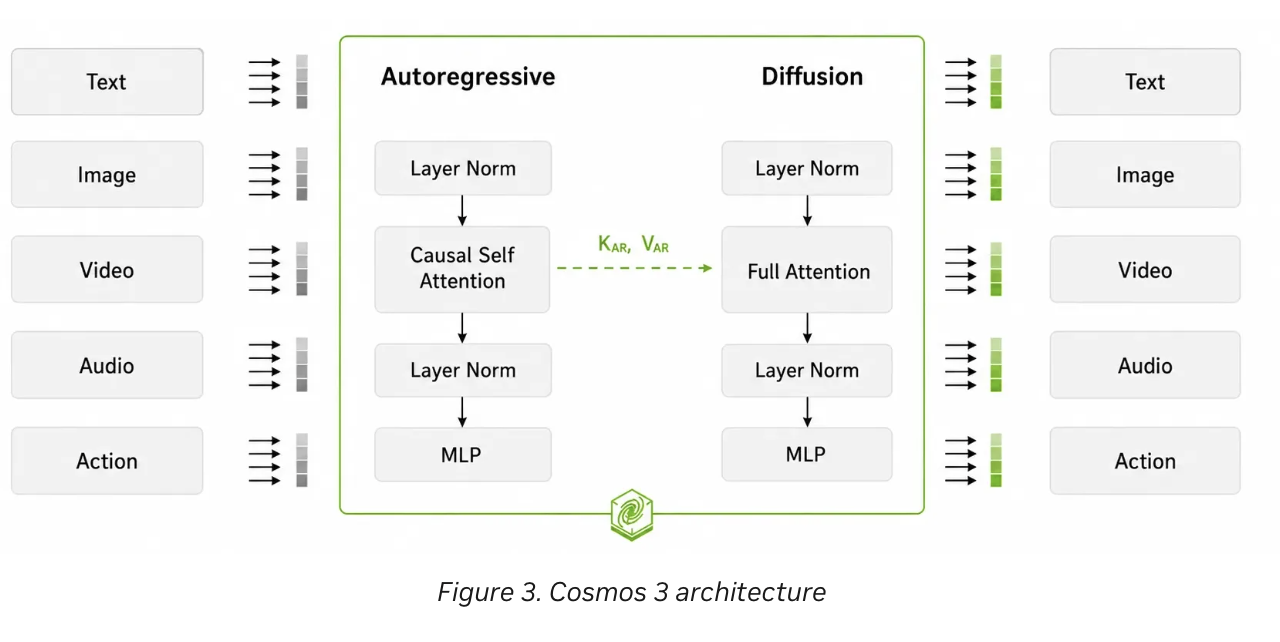
- The new architecture, a Mixture-of-Transformers (MoT) featuring two distinct towers, consolidates capabilities previously requiring separate models.
- NVIDIA has open-sourced all critical components, including model checkpoints, training scripts, deployment tools, and associated datasets, to foster community innovation.
- Cosmos 3 is primarily targeting high-impact applications in robotics, autonomous vehicles, and advanced warehouse monitoring systems.
- The model’s design emphasizes the foundational principle that physical AI systems must first understand their environment before executing actions.
What Happened
NVIDIA’s AI research division recently unveiled Cosmos 3, marking a notable advancement in the field of physical AI. This latest iteration represents a strategic consolidation of core AI functions: physical reasoning, the generation of simulated worlds, and the formulation of actionable decisions. Unlike its predecessors, which often relied on a modular separation of these complex tasks, Cosmos 3 integrates them into a single, cohesive architecture. This unification is achieved through a sophisticated Mixture-of-Transformers (MoT) framework, specifically designed with a dual-tower structure.
The core of Cosmos 3 comprises two primary components: a reasoner tower and a generator tower. The reasoner tower functions as a vision-language model (VLM), adept at interpreting intricate visual data from images and videos, alongside textual information, through an autoregressive mechanism. This tower is engineered to discern motion dynamics, understand object interactions, and interpret broader physical contexts, effectively acting as the model’s cognitive core. Complementing this, the generator tower is responsible for producing future observations, enabling predictive capabilities crucial for navigating and interacting with real-world scenarios. NVIDIA has committed to open-sourcing the entire suite of resources, including the model checkpoints, training methodologies, deployment utilities, and the underlying datasets, empowering developers and researchers to implement and expand upon this technology.
The strategic release of Cosmos 3 is directly aimed at critical sectors where physical AI interaction is paramount. Robotics, autonomous driving, and advanced warehouse logistics systems stand to benefit significantly from a model that can perceive, predict, and act within complex physical environments. By providing a unified framework, NVIDIA addresses a fundamental challenge in these domains: ensuring that intelligent agents possess a deep, integrated understanding of the world before initiating any physical action. This holistic approach is expected to streamline development cycles and enhance the reliability of AI systems operating in dynamic, real-world conditions.
Why It Matters
The introduction of NVIDIA Cosmos 3 signifies a substantial shift in the foundational approach to physical AI. By unifying physical reasoning, world generation, and action generation into a single architecture, NVIDIA is directly addressing the long-standing challenge of creating truly intelligent agents that can operate autonomously and reliably in complex physical environments. This consolidation moves beyond siloed AI capabilities, paving the way for more coherent and context-aware systems in critical applications.
For businesses, this development has profound implications, particularly in sectors reliant on automated physical tasks. Manufacturers, logistics companies, and developers of autonomous systems can anticipate more efficient development pipelines and potentially higher performing, safer AI deployments. The open-sourcing of Cosmos 3 components further democratizes access to advanced physical AI capabilities, potentially accelerating innovation across a broader spectrum of enterprises, from startups to established industry players. This move could also intensify competition among AI hardware and software providers, as the race to enable more sophisticated physical AI systems heats up.
The user impact extends to the end-products and services powered by such AI. Imagine more intuitive and safer autonomous vehicles, highly efficient and adaptable robotic systems in factories, and proactive monitoring in warehouses that can predict and prevent issues before they occur. The ability for AI to “understand” the physical world before acting is not merely an academic achievement; it is a fundamental requirement for the widespread adoption and trust in next-generation AI systems. This release by NVIDIA fundamentally alters the competitive dynamics in physical AI, setting a new benchmark for integrated intelligence.
Industry Impact
NVIDIA’s Cosmos 3 directly impacts several key industries by offering a more integrated and capable foundation for physical AI. In robotics, this means a significant leap towards robots that can not only perform tasks but also understand the nuances of their environment, predict outcomes, and adapt their actions accordingly. This could lead to faster deployment cycles and more versatile robots in manufacturing, service industries, and exploration. The ability to generate accurate world models internally allows for more robust simulation and testing, reducing the need for extensive physical prototyping.
The autonomous vehicles (AV) sector stands to gain immensely. For AVs, understanding the physical world—from pedestrian intent to dynamic road conditions and potential hazards—is paramount. Cosmos 3’s unified approach to physical reasoning and action generation could enable AVs to perceive, predict, and react more effectively to unforeseen circumstances, enhancing safety and reliability. This could accelerate the transition from assisted driving to fully autonomous systems, addressing some of the most persistent challenges in the field.
In warehouse monitoring and logistics, the implications are equally significant. AI systems can now move beyond simple object detection to understanding complex interactions between goods, machinery, and personnel. This enables predictive maintenance, optimized routing for automated guided vehicles (AGVs), and proactive identification of inefficiencies or safety risks. For instance, a system could not only identify a misplaced item but also predict its impact on workflow and generate corrective actions. The open-source nature of the model further encourages rapid experimentation and tailored solutions for specific logistical challenges, potentially leading to a wave of innovation in supply chain automation.
Expert Analysis
The unveiling of NVIDIA Cosmos 3 represents a crucial evolutionary step in the development of embodied AI. By consolidating physical reasoning, world generation, and action generation into a single, open-source model, NVIDIA is not merely offering a new tool; it is providing a unified cognitive architecture for intelligent agents. This approach directly addresses the limitations of earlier modular systems, where the handoff between perception, prediction, and action often introduced latencies and inconsistencies, hindering real-world performance and robustness. The Mixture-of-Transformers architecture, with its distinct reasoner and generator towers, provides a powerful framework for integrating multimodal data and generating coherent, physically plausible responses.
This integration is particularly impactful because it mimics a more holistic understanding of the world, akin to biological intelligence. The reasoner tower, functioning as a vision-language model, interprets complex physical contexts, while the generator tower actively constructs future possibilities. This symbiotic relationship allows for a deeper internal representation of the environment, enabling agents to not only react to present stimuli but also to proactively anticipate and plan. The decision to open-source the entire package—checkpoints, scripts, and datasets—is a strategic move that will likely galvanize research and development across various institutions, fostering a collaborative ecosystem around this unified paradigm.
Competitive Landscape
NVIDIA’s release of Cosmos 3 directly impacts the competitive landscape for foundational models aimed at physical AI. While many players, including Google DeepMind, OpenAI, and various robotics startups, are investing heavily in multimodal AI and embodied intelligence, Cosmos 3 distinguishes itself by explicitly unifying these three critical functions—reasoning, world generation, and action generation—within a single, open-source framework. This contrasts with approaches that might develop sophisticated perception models separately from planning algorithms or world simulators.
Competitors like Google DeepMind, with initiatives such as RT-X and various large language models extended for robotics, are also pushing the boundaries of generalist robots. However, the direct integration of a world generator alongside a reasoner and action generator in an open-source package could give Cosmos 3 a distinct advantage in terms of ease of deployment and holistic performance for specific use cases like autonomous vehicles and industrial robotics. OpenAI’s work on multimodal models like GPT-4V also demonstrates strong reasoning capabilities, but their explicit focus has not been on the deep physical world modeling and action generation for robotics in the same unified, open-source manner as Cosmos 3.
Furthermore, various specialized robotics companies are developing proprietary solutions for perception and control. NVIDIA’s move to open-source Cosmos 3 could either empower these companies to build on a robust foundation or compel them to accelerate their own internal research to remain competitive. The availability of training scripts and datasets lowers the barrier to entry for smaller teams and academic institutions, potentially fostering a new wave of innovation that could challenge established players. This positions NVIDIA not just as a hardware provider, but as a key enabler and architect of the future of physical AI software.
Future Implications
In the near-term (3–6 months), the open-sourcing of Cosmos 3 will likely lead to a surge in academic research and experimental projects focused on applying the unified model to various physical AI challenges. We can expect to see early prototypes in university labs and startup incubators leveraging the provided checkpoints and datasets to test its capabilities in simulated and constrained real-world environments. This period will be crucial for identifying initial strengths, weaknesses, and potential areas for refinement within the Cosmos 3 framework.
Medium-term (1–2 years) implications include the integration of Cosmos 3’s core architecture into commercial robotics platforms and autonomous vehicle development kits. As developers become more familiar with the model, we will see its components being adapted and fine-tuned for specific industrial applications, leading to more intelligent and adaptable automated systems in logistics, manufacturing, and potentially even consumer robotics. The open-source nature will foster a community-driven development cycle, with contributions and extensions building upon NVIDIA’s foundation.
Long-term (3–5 years), Cosmos 3, or its future iterations, could become a foundational standard for physical AI development, much like popular large language models are for generative AI. This could lead to a new generation of highly autonomous agents capable of complex decision-making and interaction in unstructured environments, driving significant advancements in areas like smart cities, disaster response robotics, and personalized automation. The continued unification of perception, reasoning, and action will push the boundaries of what is possible for AI in the physical world, ultimately leading to more sophisticated and human-like machine intelligence.
Actionable Insights
- Evaluate Integration Potential: Robotics and autonomous systems developers should immediately assess how Cosmos 3’s unified architecture can be integrated into their existing perception, planning, and control pipelines to streamline development.
- Explore Open-Source Resources: Download and experiment with the open-sourced checkpoints, training scripts, and datasets to gain hands-on experience and identify specific applications for your projects.
- Invest in Multimodal Data Collection: Companies in target industries should prioritize collecting high-quality, multimodal data (vision, language, motion) to fine-tune Cosmos 3 or similar models for their unique operational environments.
- Formulate Pilot Programs: Robotics and logistics firms should initiate pilot programs to test Cosmos 3’s capabilities in controlled environments, focusing on its physical reasoning and action generation for specific tasks like inventory management or automated navigation.
- Monitor Community Developments: Stay engaged with the NVIDIA AI community and broader physical AI research to track updates, new applications, and best practices emerging from the open-source ecosystem.
- Upskill AI Engineering Teams: Train AI engineers on Mixture-of-Transformers architectures and vision-language model integration to effectively deploy and customize advanced physical AI solutions like Cosmos 3.
What is NVIDIA Cosmos 3?
NVIDIA Cosmos 3 is a new family of omnimodal world models for physical AI that unifies physical reasoning, world generation, and action generation within a single, open-source model. It is designed to enable intelligent agents to understand and interact with the physical world more holistically.
What makes Cosmos 3 different from previous models?
Unlike earlier Cosmos releases that split tasks across separate models, Cosmos 3 unifies these capabilities using a Mixture-of-Transformers (MoT) architecture with two main towers: a reasoner (VLM) and a generator. This integration allows for a more cohesive perception-prediction-action loop.
Which industries will benefit most from Cosmos 3?
Cosmos 3 is primarily targeted at industries requiring advanced physical AI, including robotics, autonomous vehicles, and warehouse monitoring. Its unified capabilities aim to enhance the perception, prediction, and action generation for machines in these complex environments.
Is NVIDIA Cosmos 3 open source?
Yes, NVIDIA has open-sourced the complete Cosmos 3 package, including the model checkpoints, training scripts, deployment tools, and associated datasets. This allows researchers and developers to access, implement, and build upon the technology.
What are the two main components of Cosmos 3’s architecture?
Cosmos 3 is built around a two-tower Mixture-of-Transformers architecture. The reasoner tower is a vision-language model (VLM) that interprets physical context, while the generator tower produces future observations and world states.
Key Takeaways
- NVIDIA’s Cosmos 3 unifies physical reasoning, world generation, and action generation into a single, open-source foundation model.
- The model employs a Mixture-of-Transformers architecture with distinct reasoner and generator towers for comprehensive physical AI capabilities.
- Cosmos 3 is specifically designed to accelerate development in robotics, autonomous vehicles, and advanced warehouse monitoring systems.
- NVIDIA has open-sourced all critical components, including checkpoints, training scripts, and datasets, fostering broad community adoption.
- This release sets a new benchmark for integrated physical AI, enabling systems to understand the world before acting within it.