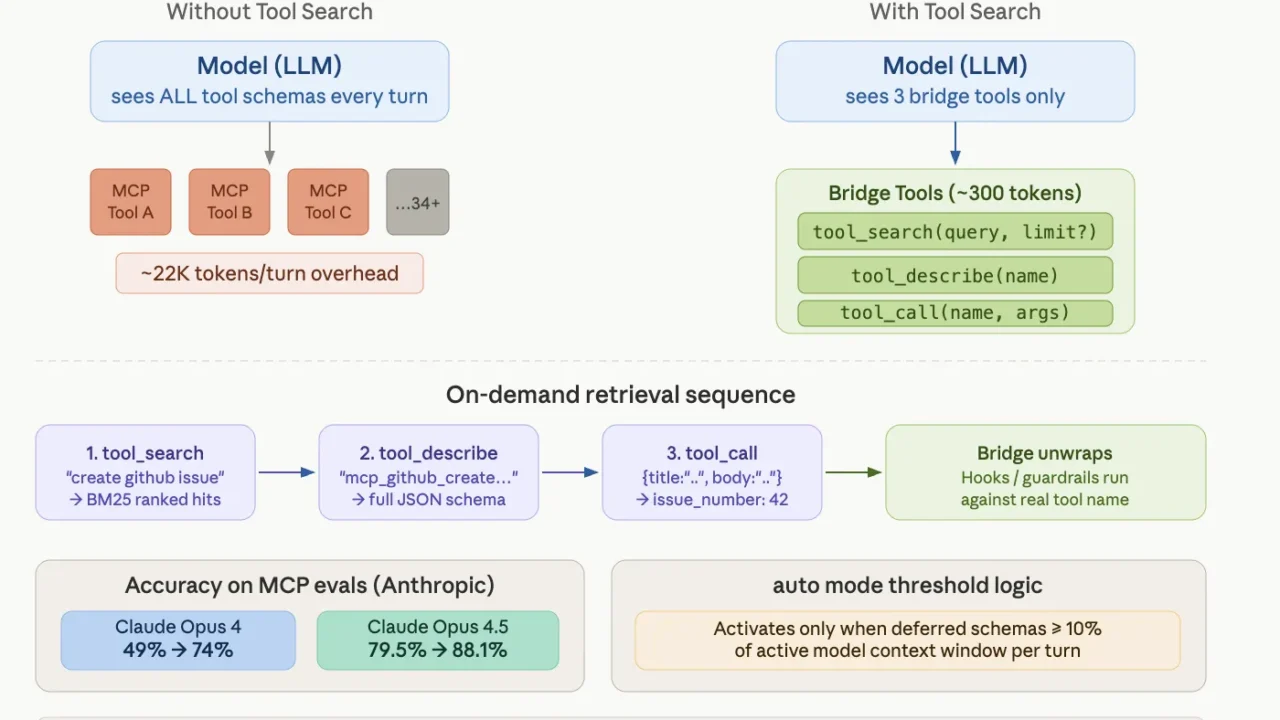
Nous Research has unveiled a significant enhancement to its open-source Hermes Agent, introducing a Tool Search feature that promises to boost AI agent accuracy by
on Anthropic’s Opus 4 models. This innovation directly addresses the growing challenge of managing an expanding array of Model Context Protocol (MCP) tools within AI agent systems, where an excess of tools can overwhelm context windows. By intelligently filtering and selecting relevant tools, Hermes aims to dramatically reduce token overhead and improve the efficiency of complex AI tasks. This development is critical for enterprises deploying sophisticated AI agents, as it directly impacts operational costs and the reliability of AI-driven workflows.
Key Developments
- Nous Research’s Hermes Agent now includes a Tool Search feature designed to optimize AI agent performance.
- The new feature tackles the problem of excessive MCP tool schemas consuming large portions of the AI model’s context window.
- Anthropic’s evaluations show that Tool Search can increase AI agent accuracy on Opus 4 by 49% to 74%.
- This enhancement significantly reduces the token overhead associated with tool definitions, making AI agents more efficient and cost-effective.
- The innovation is particularly relevant for real-world deployments involving numerous specialized tools and complex tasks.
What Happened
Nous Research, a prominent entity in open-source AI development, recently integrated a sophisticated Tool Search capability into its Hermes Agent. This update directly confronts a critical bottleneck experienced by AI agent systems: the burgeoning size of context windows due to the proliferation of Model Context Protocol (MCP) tools. In typical setups, when an AI agent connects to multiple MCP servers, the JSON schema for every single available tool is transmitted to the underlying language model during each interaction turn, regardless of whether those tools are pertinent to the current task.
This “always-on” transmission of tool definitions leads to substantial inefficiencies. For instance, a Hermes deployment utilizing five MCP servers and a total of 34 tools exhibited average prompt sizes reaching approximately 45,000 tokens per turn. A staggering
, or about 50%, of this total token count was solely attributed to the overhead of tool schemas. The problem is not unique to Hermes; internal engineering data from Anthropic itself indicates that tool definitions can consume up to 134,000 tokens before any meaningful task-specific information is even processed by the model.
The newly introduced Tool Search feature in Hermes addresses this by intelligently identifying and presenting only the necessary tools to the agent for a given task. This targeted approach prevents the model’s context window from being unnecessarily bloated with irrelevant tool schemas. By selectively feeding the model only the most pertinent information, the system can operate with greater focus and reduced computational burden, thereby enhancing both performance and cost efficiency.
Why It Matters
The integration of Tool Search into the Hermes Agent marks a pivotal moment for the practical deployment and scalability of AI agents across various industries. The issue of context window saturation, often termed “tool bloat,” has been a quiet but persistent drain on resources and a significant impediment to the reliability of complex AI systems. By addressing this fundamental challenge, Nous Research has paved the way for more efficient, accurate, and cost-effective AI operations.
For businesses, this translates directly into tangible benefits. Reduced token usage means lower API costs when interacting with large language models, a critical factor for enterprise-scale deployments where thousands or millions of interactions occur daily. Furthermore, the enhanced accuracy demonstrated by Anthropic’s evaluations suggests that AI agents can now undertake more intricate tasks with greater confidence, minimizing errors and improving decision-making processes. This development is not merely a technical tweak; it represents a foundational improvement in how AI agents interact with their operational environments, making them more robust and dependable tools for automation and complex problem-solving.
Industry Impact
The implications of Hermes Agent’s Tool Search extend far beyond individual deployments, promising a ripple effect across the broader AI and technology ecosystem. Industries heavily reliant on complex, multi-tool AI agents—such as financial services for automated trading and fraud detection, healthcare for diagnostic support and personalized treatment plans, and manufacturing for supply chain optimization and predictive maintenance—stand to benefit immensely. These sectors often require agents to access a vast array of specialized databases, APIs, and computational tools, making them particularly vulnerable to the context window limitations that Tool Search now mitigates.
Consider the impact on AI development itself. By providing a more efficient framework for tool integration, developers can now design more sophisticated agents without constantly battling context window constraints. This could accelerate the creation of truly general-purpose AI agents capable of handling a wider range of tasks with fewer compromises. Companies like Google, Microsoft, and OpenAI, which are heavily invested in agentic AI research and deployment, will likely observe and adapt similar strategies to enhance their own offerings, potentially leading to a new standard for agent efficiency. The ability to dynamically select tools also reduces the cognitive load on developers, allowing them to focus on core logic rather than intricate prompt engineering to manage tool visibility.
Expert Analysis
The introduction of Tool Search by Nous Research represents a pragmatic and necessary evolution in AI agent architecture. For too long, the default approach to tool integration has been a brute-force method, where every available function signature is presented to the language model on every turn. This “everything but the kitchen sink” strategy, while simple to implement initially, quickly becomes unsustainable as the number of tools grows, leading to prohibitive costs and degraded performance.
This development aligns with a growing industry consensus that true agentic intelligence requires more than just powerful base models; it demands sophisticated orchestration layers that manage resources intelligently. The gain in accuracy, particularly on advanced models like Anthropic’s Opus 4, underscores the fact that context quality is as important as context quantity. When a model receives a cleaner, more relevant set of tools, its reasoning capabilities are naturally amplified, leading to better outcomes and fewer “hallucinations” or irrelevant actions.
Competitive Landscape
The release of Hermes Agent’s Tool Search feature introduces a new benchmark for efficiency and accuracy in the competitive landscape of AI agent development. While major players like OpenAI with their Function Calling API and Google with their Gemini models offer robust tool integration capabilities, the explicit focus on intelligent tool selection to optimize context windows distinguishes this particular innovation. Most existing frameworks still largely rely on the developer to manage tool visibility, or they employ less sophisticated methods for dynamic tool surfacing.
This move by Nous Research, an open-source entity, could prompt a rapid response from commercial AI providers. We may see an acceleration in the development of similar context-aware tool orchestration mechanisms within proprietary platforms. Startups focused on AI agent infrastructure, like LangChain and LlamaIndex, which provide frameworks for building and deploying agents, will likely integrate or adapt similar “smart search” functionalities to remain competitive. The market is increasingly valuing not just the raw power of foundational models, but also the efficiency and intelligence of the surrounding agentic tooling and orchestration layers.
Future Implications
The immediate future (3-6 months) will likely see rapid adoption of similar context-aware tool selection mechanisms across various open-source and proprietary AI agent frameworks. Developers will prioritize integrating these features to mitigate escalating token costs and enhance agent reliability, leading to a de facto standard for efficient tool management.
In the medium term (1-2 years), this intelligent tool orchestration will enable the development of significantly more complex and autonomous AI agents. We can expect to see agents capable of navigating vast “tool libraries” with hundreds or even thousands of specialized functions, dynamically assembling sophisticated workflows without human intervention, particularly in areas like scientific research, complex data analysis, and multi-domain problem-solving. This will also drive innovation in meta-learning for tool selection, where agents learn which tools are most effective in specific contexts.
Longer term (3-5 years), the principles behind Tool Search will likely evolve into advanced “tool discovery” and “tool creation” capabilities. AI agents might not only select existing tools but also dynamically generate novel, task-specific tools or sub-agents on the fly, further blurring the lines between static programming and dynamic, adaptive AI. This could lead to truly self-improving AI systems that autonomously expand their own functional capabilities.
Actionable Insights
- Evaluate your current AI agent deployments for context window bloat caused by excessive tool schemas.
- Explore open-source agent frameworks like Hermes that are integrating advanced tool search and selection capabilities.
- Prioritize monitoring token usage and associated costs in your AI agent operations to identify areas for efficiency gains.
- Investigate methods for dynamically providing tools to your agents, rather than presenting all available tools simultaneously.
- Consider the potential for increased accuracy and reliability in your AI-driven processes by optimizing tool interaction.
- Encourage your development teams to experiment with selective tool presentation to improve agent performance.
What is Hermes Agent’s Tool Search feature?
Hermes Agent’s Tool Search is a new capability that intelligently selects and presents only the relevant tools to an AI model for a given task. This prevents the model’s context window from being overwhelmed by unnecessary tool schemas, improving efficiency and accuracy.
How does Tool Search improve AI agent performance?
By reducing the amount of irrelevant information in the context window, Tool Search allows the AI model to focus more effectively on the task at hand. This leads to a significant reduction in token usage and, as shown by Anthropic’s evaluations, a 49% to 74% gain in accuracy on Opus 4 models.
Why are too many MCP tools a problem for AI agents?
When an AI agent connects to multiple Model Context Protocol (MCP) servers, the JSON schema for every tool is sent to the language model on every turn. This “tool bloat” consumes a large portion of the context window, leading to higher token costs and reduced reasoning capabilities as the model struggles to parse vast amounts of irrelevant data.
Which industries will benefit most from this innovation?
Industries requiring complex AI agents with access to numerous specialized tools, such as financial services, healthcare, manufacturing, and scientific research, stand to benefit significantly. The efficiency gains translate directly into cost savings and improved reliability for their AI-driven operations.
Is Tool Search an open-source or proprietary solution?
Hermes Agent, including its new Tool Search feature, is an open-source project developed by Nous Research. This makes the technology accessible to a wide range of developers and organizations looking to enhance their AI agent capabilities.
Key Takeaways
- Nous Research’s Hermes Agent now includes a Tool Search feature to optimize AI agent context windows.
- This innovation significantly reduces token overhead by dynamically selecting only relevant tools for a task.
- Anthropic evaluations demonstrate a 49% to 74% accuracy gain on Opus 4 models due to Tool Search.
- The feature addresses the critical problem of “tool bloat” which consumes valuable context window space and increases costs.
- This development sets a new standard for efficient and reliable AI agent deployment across various industries.