
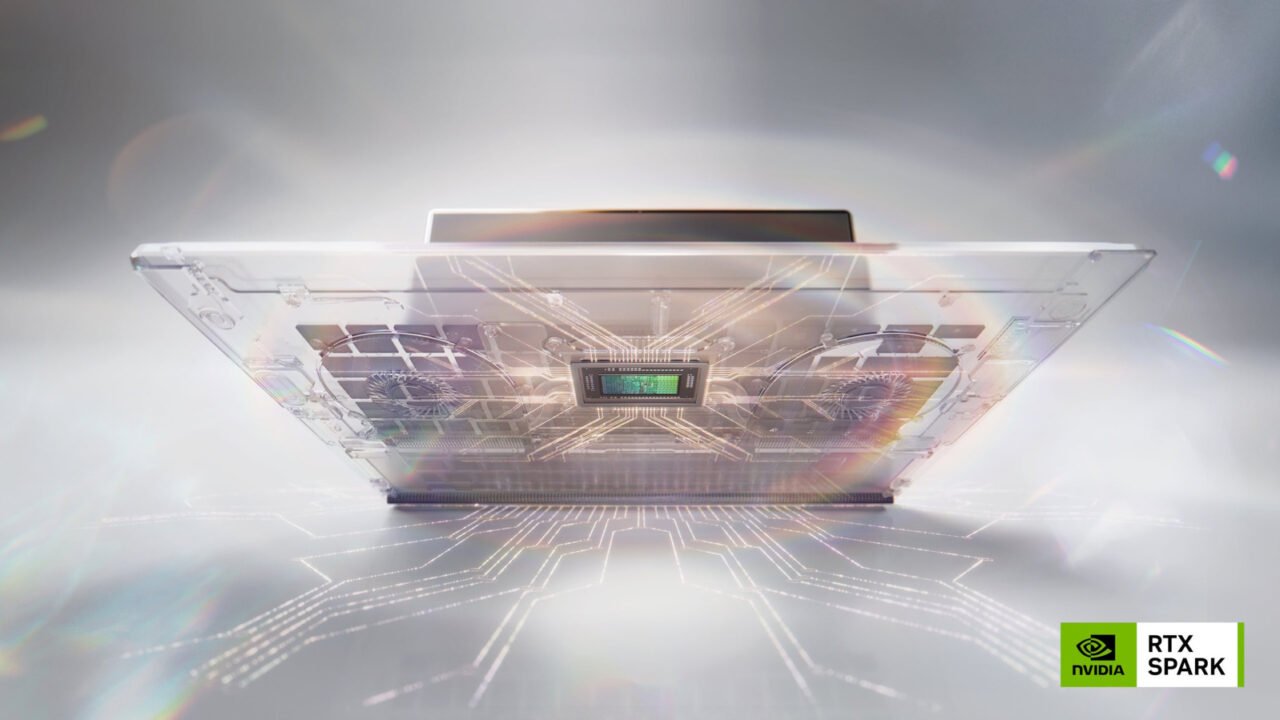
NVIDIA’s RTX Spark, a newly unveiled “superchip,” promises a staggering
for upcoming Windows laptops and desktops. Introduced at Computex, this system-on-a-chip (SOC) directly challenges offerings from AMD and Qualcomm by integrating high-performance AI and graphics capabilities into a compact design. This development signifies a major strategic pivot for NVIDIA, extending its AI dominance from data centers to the vast consumer PC market. For professionals relying on local AI acceleration and demanding graphics, the RTX Spark could redefine the performance ceiling for everyday computing.
Key Developments
- NVIDIA has officially launched the RTX Spark, a new “superchip” designed to power Windows laptops and small desktop systems.
- The RTX Spark is claimed to deliver 1 petaflop of AI computing power, setting a new benchmark for on-device AI performance in consumer hardware.
- This system-on-a-chip (SOC) integrates both fast AI processing and graphics capabilities, positioning it as a direct competitor to AMD’s Ryzen AI Max and Qualcomm’s Snapdragon X2 chips.
- Major OEMs, including Dell and Microsoft for its Surface Laptop Ultra, are expected to incorporate the RTX Spark into their new product lines.
- The introduction of RTX Spark marks NVIDIA’s strategic expansion of its AI hardware influence from specialized data center solutions to mainstream consumer computing platforms.
What Happened
NVIDIA, a dominant force in high-performance computing and artificial intelligence, officially introduced its RTX Spark “superchip” at Computex on June 1, 2026. This announcement confirms industry speculation regarding NVIDIA’s entry into the integrated system-on-a-chip (SOC) market for consumer PCs, directly targeting the burgeoning demand for on-device AI capabilities. The RTX Spark is engineered to provide both substantial AI processing power and robust graphics performance within a single chip, making it suitable for a new generation of Windows laptops and compact desktop machines.
The company asserts that the RTX Spark will deliver an unprecedented
, a figure that places it at the forefront of AI acceleration in the personal computing space. This level of performance is designed to enable sophisticated AI tasks, from real-time language processing and advanced image generation to complex data analysis, directly on a user’s device without constant cloud reliance. NVIDIA has confirmed that the RTX Spark will be integrated into new models from “every single major OEM,” including notable devices like the Surface Laptop Ultra and the Dell XPS 16.
This strategic move positions the RTX Spark as a portable counterpart to NVIDIA’s high-end DGX Spark AI mini-desktop, albeit optimized for the Windows operating system rather than Linux. While specific technical details regarding its architecture remain undisclosed, the chip is clearly designed to challenge the integrated AI capabilities of AMD’s Ryzen AI Max and Qualcomm’s latest Snapdragon X2 processors. The unveiling underscores NVIDIA’s commitment to democratizing advanced AI processing, making it accessible to a broader user base beyond specialized enterprise and data center applications.
Why It Matters
The introduction of NVIDIA’s RTX Spark represents a significant inflection point for the personal computing industry, fundamentally altering the competitive landscape for integrated processors. By bringing petaflop-scale AI performance to Windows laptops and desktops, NVIDIA is not merely launching a new chip; it is setting a new standard for what consumers and professionals can expect from their devices. This immediately elevates the capabilities of local AI inference, reducing latency and enhancing privacy for a wide array of applications that previously relied on cloud services.
For businesses, the implications are substantial. Creative professionals, data scientists, and engineers will gain access to unprecedented local processing power for tasks like high-fidelity video rendering, complex simulations, and large language model inference. This could accelerate workflows, enable new forms of on-device collaboration, and reduce operational costs associated with cloud computing. The integration into major OEM lines ensures broad market availability, pushing the entire PC ecosystem towards more powerful, AI-centric hardware designs.
The RTX Spark also intensifies the battle for market share among chip manufacturers. AMD and Qualcomm, who have recently made strides in AI-enabled SOCs, now face a formidable challenger with NVIDIA’s established brand recognition in AI and graphics. This competition will likely drive further innovation and price competitiveness, ultimately benefiting end-users. Moreover, the shift towards powerful local AI capabilities could influence software development, encouraging developers to create more sophisticated on-device AI applications that leverage this new hardware paradigm.
Head-to-Head Comparison
| Feature | NVIDIA RTX Spark | Qualcomm Snapdragon X2 |
|---|---|---|
| Pricing | Expected premium tier | Premium tier |
| Performance | 1 petaflop AI computing (claimed) | High-performance NPU (specific petaflop not publicly stated for X2) |
| Best For | High-end AI applications, graphics-intensive tasks, professional workstations | Thin & light laptops, long battery life, general productivity with AI acceleration |
| Key Strength | Raw AI computing power, integrated graphics performance, extensive AI software ecosystem | Power efficiency, always-on connectivity, ARM architecture benefits |
| Main Weakness | Potentially higher power consumption, unconfirmed battery life metrics | Historically lower raw graphics power compared to discrete GPUs |
Industry Impact
The ramifications of NVIDIA’s RTX Spark extend across numerous sectors of the AI and broader technology ecosystem. Hardware manufacturers will undoubtedly accelerate their roadmaps for AI-powered devices, with a clear incentive to integrate these “superchips” to remain competitive. This will likely lead to a new wave of PC designs focused on thermal management, power delivery, and connectivity optimized for intense AI workloads. The laptop and desktop markets, which have seen a resurgence in innovation, are poised for another significant transformation driven by this enhanced local processing capability.
Software developers stand to gain immensely. With a guaranteed baseline of petaflop-level AI performance on millions of Windows machines, the potential for sophisticated on-device AI applications explodes. Industries such as media and entertainment, engineering, scientific research, and even enterprise productivity tools will see new possibilities. Imagine video editors rendering complex effects with AI acceleration in real-time on a laptop, or architects running generative design simulations locally without relying on costly cloud GPU instances. This democratizes access to high-end computational power that was previously confined to specialized workstations or cloud infrastructure.
Furthermore, the competitive dynamic between chipmakers will intensify. AMD and Qualcomm, who have invested heavily in their own integrated AI solutions, will be compelled to respond with even more powerful or efficient offerings. This healthy competition benefits the entire industry by accelerating technological advancement and potentially driving down costs over time. The ripple effect will also touch component suppliers, cooling solution providers, and even memory manufacturers, as the demands of these AI superchips necessitate advancements across the entire hardware stack. The push towards more powerful edge computing also has implications for data privacy and security, as more sensitive data processing can occur locally.
Expert Analysis
NVIDIA’s entry into the mainstream Windows SOC market with the RTX Spark is a calculated and strategic maneuver, reflecting the company’s long-term vision for pervasive AI. While NVIDIA has historically dominated discrete graphics and data center AI, this move signals a clear intent to capture the rapidly expanding market for on-device AI. The 1 petaflop claim is not merely a marketing number; it represents a significant leap in local AI processing that could fundamentally alter how software is developed and consumed. This is not just about faster performance; it’s about enabling entirely new user experiences that are currently impractical or impossible without cloud intervention.
The timing is also critical, aligning with Microsoft’s increased focus on AI integration within Windows and its own hardware. The deep integration with major OEMs like Dell and Microsoft suggests a concerted effort to establish the RTX Spark as a foundational component for the next generation of AI PCs. This symbiotic relationship could create a powerful ecosystem advantage for NVIDIA, leveraging its existing CUDA platform and developer tools to attract a broad base of AI application developers. The challenge will be balancing this raw power with thermal management and battery life, particularly in the laptop form factor.
Competitive Landscape
The launch of NVIDIA’s RTX Spark significantly reshapes the competitive dynamics within the integrated processor market for Windows PCs. Historically, Intel and AMD have dominated this space with their CPU-centric architectures, gradually incorporating AI acceleration units (NPUs). More recently, Qualcomm has emerged as a serious contender with its Snapdragon X series, leveraging ARM architecture for power efficiency and strong on-device AI capabilities, particularly in thin and light form factors. The RTX Spark directly challenges both these established players and the newer entrants.
AMD, with its Ryzen AI Max series, has been pushing integrated AI performance, combining powerful CPU cores with dedicated AI engines. Qualcomm’s Snapdragon X2, similarly, emphasizes its NPU for efficient AI inference. NVIDIA’s approach with the RTX Spark, however, appears to be a full-stack AI and graphics powerhouse, leveraging its deep expertise in GPU-accelerated computing. This positions NVIDIA uniquely, as it can offer not only strong AI but also industry-leading graphics performance, which is a critical differentiator for creative professionals, gamers, and scientific users.
The battle will now center on not just raw AI performance but also power efficiency, software ecosystem support, and overall system integration. While NVIDIA has a robust AI software stack (CUDA, TensorRT), AMD and Qualcomm are also building out their respective developer tools and platforms. The success of the RTX Spark will depend on its ability to deliver on its performance promises while maintaining competitive power envelopes and securing broad adoption across diverse PC segments, from ultraportables to small form factor desktops.
Future Implications
Near-term (3-6 months): The immediate future will see a rapid proliferation of “AI PCs” featuring the RTX Spark, with major OEMs showcasing their new laptop and desktop models. Developers will begin optimizing existing AI applications and creating new ones specifically to leverage the RTX Spark’s petaflop-level capabilities, driving a surge in on-device AI software innovation.
Medium-term (1-2 years): The intense competition among NVIDIA, AMD, and Qualcomm will accelerate chip development cycles, leading to even more powerful and efficient integrated AI processors. We can expect to see a significant shift in user expectations, with local AI processing becoming a standard feature rather than a premium one, influencing operating system designs and user interfaces to be more AI-centric.
Long-term (3-5 years): The widespread adoption of superchips like the RTX Spark will fundamentally alter computing paradigms. Cloud reliance for many AI tasks will diminish, leading to enhanced data privacy and lower operational costs for businesses. This could also enable entirely new categories of intelligent devices and pervasive AI experiences that blur the lines between physical and digital interactions, powered by omnipresent, high-performance local AI.
Actionable Insights
- Evaluate current hardware refresh cycles to align with the expected launch of RTX Spark-powered devices for enhanced AI capabilities.
- Investigate how existing cloud-based AI workloads could be migrated or offloaded to new local hardware for cost savings and improved privacy.
- Begin exploring development frameworks and tools compatible with NVIDIA’s AI ecosystem to prepare for building or optimizing on-device AI applications.
- Monitor announcements from major OEMs regarding RTX Spark integration to identify specific models that meet your performance and form factor requirements.
- Assess the potential impact on your IT infrastructure and network bandwidth requirements as more AI processing shifts from the cloud to endpoints.
- Stay informed on competitive offerings from AMD and Qualcomm to make balanced purchasing decisions based on performance, efficiency, and ecosystem support.
What is NVIDIA RTX Spark?
NVIDIA RTX Spark is a new “superchip” system-on-a-chip (SOC) designed to power Windows laptops and small desktops. It integrates powerful AI computing and graphics performance into a single chip, claiming 1 petaflop of AI processing power.
What is a petaflop of AI computing power?
A petaflop refers to a quadrillion (10^15) floating-point operations per second. In AI computing, this signifies an immense capacity for performing the complex calculations required for machine learning models, enabling rapid on-device AI inference and training.
Which devices will feature the RTX Spark?
The RTX Spark is expected to power new laptops including the Microsoft Surface Laptop Ultra and Dell XPS 16, along with systems from “every single major OEM.” This indicates broad adoption across the Windows PC market.
How does RTX Spark compare to competitors like Snapdragon X2?
The RTX Spark directly competes with integrated AI chips like Qualcomm’s Snapdragon X2 and AMD’s Ryzen AI Max. NVIDIA emphasizes its 1 petaflop AI performance and strong graphics, leveraging its established expertise in GPU-accelerated computing.
What are the main benefits of on-device AI with RTX Spark?
The primary benefits include significantly faster AI task execution, reduced reliance on cloud services for AI inference, enhanced data privacy by keeping processing local, and the ability to run more sophisticated AI applications directly on personal computers.
Key Takeaways
- NVIDIA’s RTX Spark is a new “superchip” for Windows PCs, offering 1 petaflop of AI computing power.
- This integrated SOC aims to deliver high-performance AI and graphics to laptops and small desktops.
- Major OEMs like Microsoft and Dell are confirmed to integrate the RTX Spark into upcoming devices.
- The RTX Spark directly challenges AMD’s Ryzen AI Max and Qualcomm’s Snapdragon X2 in the AI PC market.
- Its launch signifies a major shift towards powerful, ubiquitous on-device AI processing in consumer computing.