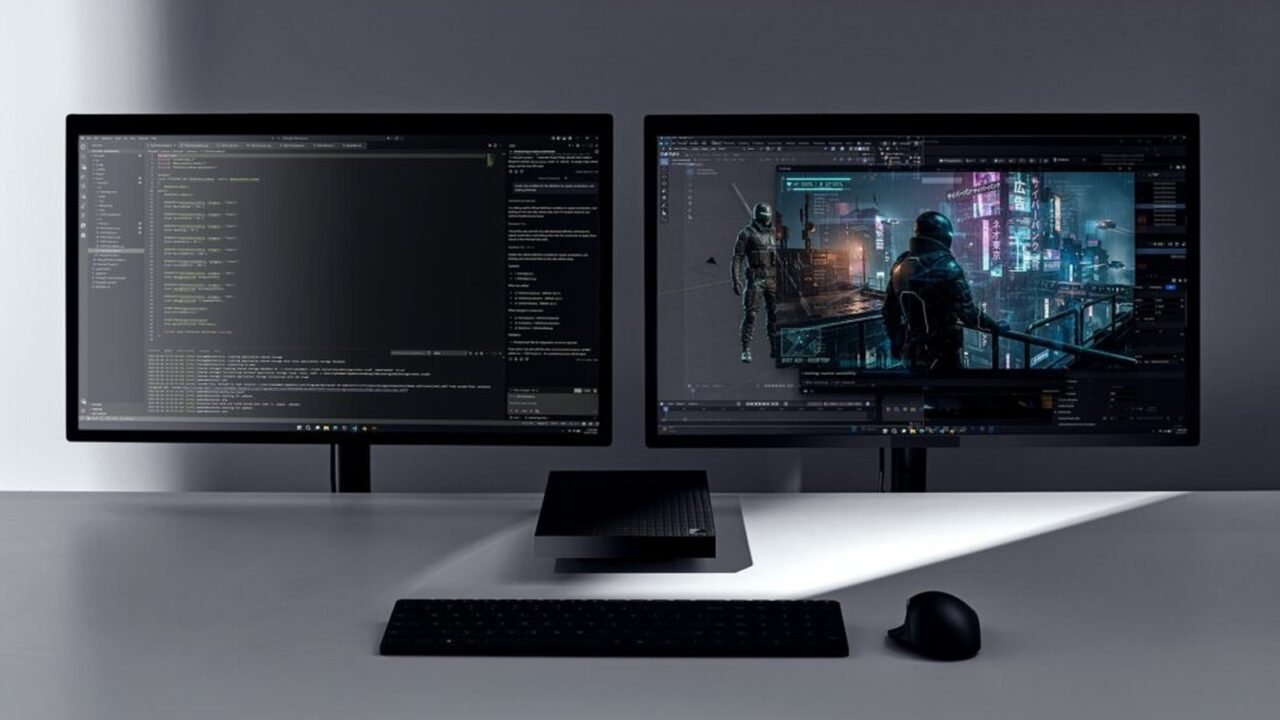
Microsoft’s Surface RTX Spark Dev Box, unveiled at Build, represents a significant entry into the specialized AI workstation market, offering up to a petaflop of AI computing power. This new desktop device is specifically engineered for demanding AI workloads, such as extensive model training and complex agentic AI pipelines, distinguishing itself from its laptop counterpart, the Surface Laptop Ultra. Equipped with NVIDIA’s RTX Spark chip and supporting up to 128GB of unified memory, the Dev Box aims to provide a dedicated, high-performance environment for developers. Its introduction signals Microsoft’s strategic focus on empowering AI professionals with purpose-built hardware, addressing the growing need for sustained computational capacity in AI development.
Key Developments
- Microsoft announced the Surface RTX Spark Dev Box at Build, targeting professionals requiring dedicated AI processing power.
- The Dev Box is a desktop-oriented device, designed for sustained AI workloads like long-running training jobs and local model fine-tuning.
- It features NVIDIA’s RTX Spark chip, enabling up to 128GB of unified memory and delivering a petaflop of AI computing capability.
- With a 100W thermal envelope and low-power Arm CPUs, the device is engineered to manage significant heat generation during intensive tasks.
- This release underscores Microsoft’s commitment to providing specialized hardware solutions for the increasingly complex demands of AI development.
What Happened
Microsoft officially introduced the Surface RTX Spark Dev Box during its recent Build conference, presenting it as a robust solution for artificial intelligence developers. This new hardware is a desktop iteration, explicitly designed to provide a stable and powerful platform for intricate AI computations, moving beyond the capabilities typically offered by portable devices. The announcement highlighted the device’s capacity for handling “long-running training jobs, agentic AI pipelines, and local model fine-tuning,” according to Microsoft’s own statements, positioning it as a dedicated tool for serious AI development.
Central to the Dev Box’s performance is NVIDIA’s RTX Spark chip, which underpins its impressive specifications. This chip facilitates configurations with up to 128GB of unified memory, a crucial feature for memory-intensive AI tasks, and delivers a formidable petaflop of AI computing power. Furthermore, the Dev Box incorporates a 100W thermal envelope and utilizes low-power Arm CPUs, a design choice intended to effectively manage the substantial heat generated during prolonged, high-intensity AI operations, ensuring sustained performance without throttling.
Unlike its sibling, the Surface Laptop Ultra, which focuses on portability and integrated AI experiences, the Dev Box prioritizes raw, sustained computational horsepower. This distinction clarifies Microsoft’s strategy to cater to different segments of the AI professional market, offering a desktop alternative for those whose primary need is maximum processing capability and thermal efficiency for continuous, demanding AI development cycles rather than mobility.
Why It Matters
The introduction of the Surface RTX Spark Dev Box is a significant development for the AI industry, signaling a maturation in the hardware landscape tailored for artificial intelligence professionals. By offering a dedicated desktop solution optimized for sustained AI workloads, Microsoft is directly addressing a critical pain point for developers: the need for powerful, thermally efficient machines capable of handling compute-intensive tasks without compromise. This move validates the growing demand for specialized hardware that goes beyond general-purpose computing, acknowledging the unique requirements of AI model training, fine-tuning, and complex pipeline execution.
For businesses and research institutions, the Dev Box provides a compelling alternative to traditional server-based infrastructure or less optimized workstations. Its ability to deliver a petaflop of AI computing power locally means developers can iterate faster, maintain greater control over sensitive data, and reduce reliance on cloud resources for certain stages of development. This local processing capability can translate into significant cost savings and improved development cycles, particularly for projects requiring frequent, iterative model adjustments.
The competitive implications are also noteworthy. As AI development becomes increasingly democratized, the availability of purpose-built, high-performance local hardware can accelerate innovation across various sectors. It empowers smaller teams and individual developers to tackle more ambitious AI projects, potentially leveling the playing field against larger organizations with extensive cloud budgets. The emphasis on a 100W thermal envelope highlights the engineering effort to ensure stability under load, a crucial factor for professional use cases where uptime and consistent performance are paramount.
Industry Impact
The Surface RTX Spark Dev Box is poised to profoundly impact several sectors within the broader AI and technology ecosystem. For AI developers and data scientists, it represents a new class of workstation that prioritizes raw computational throughput and thermal management, directly affecting their workflow efficiency and the scope of projects they can undertake locally. This dedicated hardware can accelerate research and development in areas like natural language processing, computer vision, and autonomous systems, where large models and extensive datasets are commonplace.
Industries heavily reliant on localized AI processing, such as defense, healthcare, and finance, stand to benefit significantly. For instance, in healthcare, researchers developing new diagnostic AI models can conduct more iterative training and fine-tuning on sensitive patient data without needing to transfer it to external cloud environments, enhancing data security and compliance. Financial institutions can use such a device for local fraud detection model development or algorithmic trading strategy backtesting, where latency and data privacy are critical considerations. The Dev Box’s robust capabilities could also enable smaller enterprises to bring advanced AI development in-house, reducing reliance on expensive cloud services for initial development phases.
Furthermore, the availability of a powerful, specialized desktop for AI workloads could foster the growth of a new ecosystem of software tools and development environments optimized for such hardware. This could spur innovation in local AI inferencing, edge AI development, and specialized AI frameworks that can fully exploit the Dev Box’s unique architecture, including its 128GB of unified memory. The emphasis on NVIDIA’s RTX Spark chip also reinforces the strategic importance of hardware-software co-design in pushing the boundaries of AI performance, potentially influencing future chip development roadmaps across the industry.
Head-to-Head Comparison
| Feature | Surface RTX Spark Dev Box | Typical High-End AI Workstation (e.g., custom build) |
|---|---|---|
| Pricing | Likely premium, integrated ecosystem cost | Variable, depends on component selection |
| Performance | 1 Petaflop AI, up to 128GB unified memory (RTX Spark) | Can achieve similar or higher, but requires careful component matching (e.g., multiple GPUs) |
| Best For | Dedicated, sustained AI training, agentic AI pipelines, local model fine-tuning | Highly customizable AI/ML research, multi-GPU setups, specific framework optimization |
| Key Strength | Optimized integration of hardware and software, thermal management, Arm CPU efficiency | Flexibility in component choice, upgradeability, potential for extreme raw power with multiple discrete GPUs |
| Main Weakness | Potentially less customizable/upgradeable than a custom PC, reliance on Microsoft/NVIDIA ecosystem | Complexity of assembly/configuration, potential driver/software compatibility issues, higher power consumption |
Expert Analysis
The introduction of Microsoft’s Surface RTX Spark Dev Box marks a strategic inflection point in the consumer and professional AI hardware market. While high-end workstations have always existed for AI development, Microsoft’s entry with a purpose-built, integrated system carries significant weight. This device isn’t just about raw specifications; it’s about delivering a cohesive, optimized experience that minimizes setup complexities and maximizes developer productivity. The choice of NVIDIA’s RTX Spark chip, combined with Arm CPUs and a dedicated thermal envelope, suggests a thoughtful approach to balancing performance, power efficiency, and sustained operation for the most demanding AI tasks.
This move also reflects a broader industry trend towards vertical integration in AI hardware. Companies are realizing that off-the-shelf components, while powerful, often require extensive optimization to truly excel in specific AI workloads. By designing a system from the ground up for “long-running training jobs” and “agentic AI pipelines,” Microsoft is aiming for a level of system-level performance and stability that can be challenging to achieve with fragmented hardware solutions. This could set a new standard for what developers expect from an AI workstation, particularly regarding thermal management and unified memory access, which are critical for large model development.
Furthermore, the Dev Box’s existence alongside the Surface Laptop Ultra indicates a two-pronged strategy from Microsoft: one for mobile AI development and another for stationary, intensive compute. This differentiation is crucial as AI workloads diverge, with some requiring on-device inference and others demanding massive local training capabilities. The potential for a unified software stack across these devices could also be a major draw, simplifying development and deployment across Microsoft’s AI ecosystem.
Competitive Landscape
The market for high-performance AI development hardware is becoming increasingly crowded and diverse. Microsoft’s Surface RTX Spark Dev Box enters a landscape where traditional workstation manufacturers, specialized AI hardware startups, and even cloud providers offering local compute solutions are vying for developer attention. Companies like Dell, HP, and Lenovo offer powerful workstations configurable with multiple NVIDIA GPUs, providing immense raw compute but often requiring more manual optimization and integration efforts from developers. These systems typically rely on x86 architectures, contrasting with the Dev Box’s Arm CPUs.
Beyond traditional OEMs, startups are also innovating with specialized hardware. For instance, companies focusing on edge AI or specific neural network architectures might offer highly optimized, smaller-footprint devices. Cloud providers like AWS with their local compute offerings or Google’s various AI hardware initiatives also present indirect competition, as developers weigh the benefits of local processing against the scalability and managed services of the cloud. The Dev Box’s unique selling proposition lies in its tight integration of hardware and software, leveraging Microsoft’s ecosystem alongside NVIDIA’s specialized AI silicon.
The existence of Apple’s M-series chips, known for their unified memory architecture and strong performance in AI workloads on Mac devices, also sets a benchmark for integrated AI processing. While not a direct competitor in the high-end desktop workstation segment, Apple’s approach highlights the value of system-on-a-chip designs for AI. Microsoft’s adoption of the RTX Spark chip with unified memory and Arm CPUs in the Dev Box positions it as a direct challenger to systems that prioritize seamless hardware-software synergy for AI tasks, distinguishing it from more generic high-performance computing solutions.
Future Implications
Near-term (3–6 months): The immediate future will see the Dev Box establish itself as a reference platform for Windows-based AI development. We can expect an increase in developer tooling and framework optimizations specifically targeting its RTX Spark chip and Arm architecture, enhancing its utility for local fine-tuning and agentic AI pipelines. Early adopters will provide crucial feedback, guiding Microsoft’s next iterations and marketing efforts.
Medium-term (1–2 years): The success of the Dev Box could spur a broader trend of specialized AI desktop hardware from other manufacturers, potentially leading to a more segmented market for AI workstations. Microsoft might expand the Dev Box line with varying configurations, targeting different tiers of AI professionals. We could also see deeper integration with Azure AI services, creating a hybrid local-cloud development environment that leverages the strengths of both.
Long-term (3–5 years): The Dev Box’s emphasis on Arm CPUs and NVIDIA’s specialized AI silicon could influence future chip design, pushing towards more power-efficient and AI-optimized architectures across the industry. This device could become a cornerstone for the development of next-generation AI models that require unprecedented local compute, potentially accelerating advancements in fields like quantum AI simulation or highly personalized AI agents operating entirely on-device.
Actionable Insights
- Evaluate your current AI development workflow for bottlenecks related to compute power, memory, or thermal management.
- Consider how a dedicated, high-performance local workstation like the Dev Box could accelerate model training and iteration cycles.
- Investigate the compatibility of your existing AI frameworks and toolchains with Arm-based systems and NVIDIA’s RTX Spark architecture.
- Assess the potential cost savings from reducing reliance on cloud compute for frequent, iterative AI development tasks.
- Explore Microsoft’s developer ecosystem for specific tools and SDKs optimized for the Surface RTX Spark Dev Box.
- Plan for potential hardware upgrades or system integration strategies if your AI workloads are expected to scale significantly.
What is the Microsoft Surface RTX Spark Dev Box?
The Microsoft Surface RTX Spark Dev Box is a new desktop computer designed specifically for AI developers, announced at Build. It features NVIDIA’s RTX Spark chip and is optimized for sustained, demanding AI workloads like model training and fine-tuning.
What are the key specifications of the Dev Box?
The Dev Box offers up to a petaflop of AI computing power and supports up to 128GB of unified memory, powered by NVIDIA’s RTX Spark chip. It also features a 100W thermal envelope and low-power Arm CPUs for efficient heat management.
How does the Dev Box differ from the Surface Laptop Ultra?
While both devices use the RTX Spark chip, the Dev Box is a desktop unit built for sustained, heavy AI workloads and superior thermal management. The Surface Laptop Ultra is designed for portability and integrated AI experiences on a laptop form factor.
Who is the target audience for the Surface RTX Spark Dev Box?
The Dev Box is aimed at AI professionals, data scientists, and researchers who require a dedicated, high-performance workstation for intensive tasks such as long-running model training, complex agentic AI pipelines, and local model fine-tuning.
Why is unified memory important for AI workloads on the Dev Box?
Unified memory, up to 128GB on the Dev Box, allows the CPU and GPU to access the same memory pool without data transfer overhead. This significantly accelerates performance for large AI models and complex datasets, improving efficiency in training and inference.
Key Takeaways
- Microsoft launched the Surface RTX Spark Dev Box, a dedicated desktop for intensive AI workloads.
- The Dev Box features NVIDIA’s RTX Spark chip, delivering a petaflop of AI computing power and up to 128GB of unified memory.
- Its design prioritizes sustained performance and thermal management for tasks like model training and fine-tuning.
- This hardware targets AI professionals seeking powerful local compute capabilities, distinct from mobile AI devices.
- The Dev Box signifies Microsoft’s strategic commitment to specialized hardware solutions for advanced AI development.