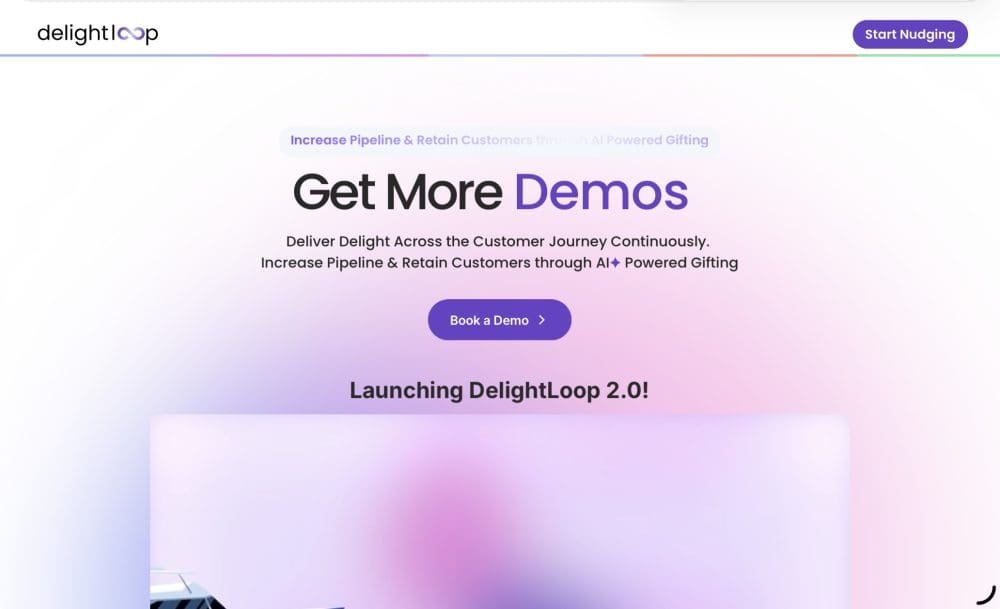
Delightloop, a new AI-powered gifting platform, is directly addressing the escalating crisis in B2B outreach, where reply rates for digital communications have plummeted amidst an explosion of AI-generated content. This innovative approach integrates physical gift delivery with advanced AI agent capabilities, aiming to re-establish human connection in a saturated digital sales environment. By moving beyond generic digital campaigns, Delightloop offers a novel solution for businesses struggling to capture prospect attention and convert leads. Its emergence signifies a critical evolution in sales and marketing technology, demanding attention from any professional seeking to optimize their B2B engagement strategies.
Key Developments
- Delightloop introduces Gifty, an AI agent designed to automate the selection and delivery of physical gifts to B2B prospects.
- The platform aims to differentiate outreach efforts by combining digital AI-SDR sequences with tangible, personalized gifts.
- This strategy targets the declining effectiveness of purely digital B2B outbound campaigns, which have suffered from oversaturation and low reply rates.
- Delightloop seeks to improve conversion rates by adding a unique physical touchpoint that stands out from typical email and digital ad campaigns.
- The solution addresses the historical inefficiencies and high costs associated with traditional B2B gifting programs.
What Happened
The B2B sales landscape has undergone a significant transformation in recent years, largely driven by the proliferation of AI-powered sales development representatives (SDRs). These AI systems became highly proficient at generating personalized outbound communications, leading to an unprecedented volume of emails and digital messages. This efficiency, however, inadvertently created a new problem: prospect inboxes became overwhelmed, resulting in a drastic reduction in reply rates and overall engagement for even well-crafted digital campaigns.
Historically, B2B gifting was a manual, often inefficient process. Field marketers dedicated hundreds of hours quarterly to sourcing items, managing logistics, and hoping gifts arrived before sales opportunities cooled. These programs were frequently viewed as “spray-and-pray” tactics, with limited measurable ROI, making them prime targets for budget cuts during economic downturns. The advent of Delightloop, featuring its core AI agent named Gifty, represents a direct response to both the digital outreach saturation and the traditional gifting inefficiencies, positioning itself as a strategic bridge between digital automation and tangible human connection.
Delightloop’s core offering is an AI-powered gifting platform built around a singular agent, Gifty. This agent integrates with existing digital outbound strategies, such as AI-SDR sequences and account-based marketing (ABM) plays, to introduce a physical gift component. The system automates the selection, personalization, and delivery of gifts, aiming to ensure they land at opportune moments in the sales cycle. This integration intends to cut through the digital noise by providing a unique, memorable touchpoint that stands apart from the torrent of digital communications.
Why It Matters
Delightloop’s emergence is not merely an incremental improvement in sales tools; it signals a strategic re-evaluation of how businesses engage prospects in an increasingly automated world. The platform addresses a critical failure point in modern B2B outreach: the collapse of reply rates due to digital channel oversaturation. By embedding physical gifts within AI-driven sequences, Delightloop attempts to restore a sense of personalization and genuine effort that has been lost in the race for digital scale. This matters because it challenges the prevailing assumption that all sales interactions can or should be purely digital.
The success of B2B sales hinges on establishing rapport and trust, which has become exponentially harder when prospects are inundated with generic-sounding, albeit AI-generated, messages. Delightloop’s approach could redefine the “top of funnel” experience, offering a distinct competitive advantage to companies willing to invest in a hybrid digital-physical outreach model. This could lead to higher engagement, better qualified leads, and ultimately, improved conversion metrics for sales teams struggling to make an impact. It also represents a significant shift from the often-dismissed practice of traditional corporate gifting towards a data-driven, strategically deployed engagement tactic.
For businesses, the ability to stand out is paramount. In a competitive market where every advantage counts, a system that can reliably increase prospect engagement and move deals forward by adding a unique physical element holds considerable value. This innovation could force many organizations to reconsider their entire outbound strategy, moving beyond the simple optimization of email templates to explore more sophisticated, multi-channel approaches that blend the efficiency of AI with the undeniable impact of a thoughtful, physical gesture.
Industry Impact
The introduction of Delightloop has significant implications for the broader AI and technology ecosystem, particularly within the sales, marketing, and customer relationship management (CRM) sectors. For years, the trend has been towards digitizing every aspect of the sales funnel, with AI-SDRs and marketing automation platforms leading the charge. Delightloop, however, suggests a counter-trend: using AI not just to automate digital interactions, but to intelligently reintroduce physical touchpoints that enhance, rather than replace, human connection.
This hybrid model could spur innovation in adjacent technologies. We might see the development of more sophisticated AI agents capable of discerning optimal gifting moments based on CRM data, prospect behavior, and even social media sentiment. Logistics and fulfillment technologies for personalized physical goods could also experience a boom, driven by the need for efficient, scalable, and globally distributed gifting services. Furthermore, the success of Delightloop could validate the investment in “phygital” (physical + digital) strategies across various industries, from recruiting to customer retention, where a tangible gesture can significantly influence outcomes.
Companies reliant on purely digital outreach, such as many SaaS providers and B2B service firms, will need to evaluate their current strategies. Those that continue to rely solely on email and digital ads risk being further marginalized as competitors adopt more integrated approaches. This could lead to a competitive arms race where the quality and personalization of outreach, both digital and physical, become key differentiators. The move also impacts the data analytics space, as measuring the ROI of physical gifts integrated with AI sequences will require new metrics and attribution models, pushing the boundaries of current marketing analytics platforms.
Expert Analysis
Delightloop’s strategy represents a sophisticated understanding of human psychology in a B2B context. While AI has excelled at scaling personalization, it often struggles with authenticity and the non-verbal cues that build genuine connection. A physical gift, thoughtfully chosen and delivered, can bypass the digital noise and create an immediate, positive impression that a thousand emails might fail to achieve. This isn’t about reverting to old methods; it’s about using advanced AI to make traditional, impactful gestures scalable and strategic.
The platform’s potential to integrate with existing AI-SDRs is particularly compelling. Instead of seeing AI as solely a digital communication tool, Delightloop positions it as an orchestration layer, determining not just what to say, but how and through which channel to say it, including the physical dimension. This intelligent allocation of resources, where a physical gift is deployed only when the AI agent identifies a high-value opportunity or a critical stage in the sales cycle, moves gifting from a cost center to a strategic investment with measurable returns. It transforms gifting from a speculative expense into a data-driven tactic designed to accelerate deal velocity and improve close rates.
This approach also forces a re-evaluation of the sales development role itself. Instead of being solely focused on digital outreach metrics, SDRs and marketers can now consider a more holistic engagement strategy that includes physical touchpoints. The AI agent, Gifty, acts as an extension of the sales team, automating the logistical complexities of gifting so that human reps can focus on higher-value activities. This synergy between AI automation and strategic human-centric gestures could set a new benchmark for B2B engagement effectiveness.
Competitive Landscape
The B2B gifting market has historically been fragmented, with numerous platforms offering gift cards, curated boxes, or promotional items. However, most of these solutions have lacked deep integration with AI-driven sales automation platforms or the intelligence to dynamically deploy gifts based on real-time sales signals. Companies like Sendoso and Postal.io have established themselves in the corporate gifting space, offering platforms for sending physical gifts and tracking delivery. Their models, however, typically rely on manual triggers or simpler automation rules.
Delightloop distinguishes itself by deeply embedding an AI agent, Gifty, as the central orchestrator of the gifting process. This is not merely an integration but a fundamental shift in how gifting decisions are made and executed. While existing players offer extensive catalogs and fulfillment networks, Delightloop’s core innovation lies in its AI’s ability to identify optimal gifting moments within complex sales sequences, effectively transforming gifting from a reactive or pre-planned activity into a proactive, AI-driven strategy. This level of intelligent automation and integration with outbound AI-SDRs creates a new category within the sales tech stack, posing a direct challenge to more traditional gifting platforms that may struggle to match the dynamic decision-making capabilities of Delightloop’s agent.
✓ Pros
- Intelligent AI agent (Gifty) automates strategic gift deployment.
- Integrates physical gifts directly into existing AI-SDR and ABM sequences.
- Addresses declining digital outreach reply rates by adding a unique touchpoint.
- Reduces manual effort and inefficiencies associated with traditional gifting.
- Potential for significantly higher engagement and conversion rates.
✗ Cons
- Higher per-contact cost compared to purely digital outreach.
- Requires careful budget management to ensure ROI.
- Logistical complexities of physical gift delivery can vary by region.
- Requires robust integration with existing CRM and sales automation tools.
- Potential for misuse if not aligned with genuine prospect value.
Future Implications
Near-term (3-6 months): Expect to see increased adoption among early-moving sales organizations eager to differentiate their outreach. Competitors in the gifting and sales automation spaces will likely announce similar AI integration initiatives, albeit perhaps less mature than Delightloop’s dedicated agent. Early case studies demonstrating tangible ROI will be critical for broader market acceptance, particularly showcasing improved reply rates and deal velocity.
Medium-term (1-2 years): The concept of AI-orchestrated physical touchpoints will likely expand beyond gifting to other areas, such as personalized print materials or event invitations, all driven by intelligent agents. Data privacy concerns around gathering information for physical delivery will become more prominent, potentially leading to new industry standards or regulatory discussions. The market will also demand more sophisticated analytics to precisely attribute the impact of physical gifts on sales pipelines, pushing the boundaries of current attribution models.
Long-term (3-5 years): AI agents like Gifty could evolve into comprehensive “experience orchestrators,” managing entire prospect journeys across digital and physical realms, dynamically adapting strategies based on real-time engagement signals. The line between AI-driven digital marketing and physical brand experiences will blur further, with AI becoming the central nervous system for all customer interactions. This could lead to a complete overhaul of how B2B sales and marketing departments are structured, with a greater emphasis on integrated “phygital” engagement teams.
Actionable Insights
- Evaluate Current Outreach Effectiveness: Analyze your current B2B digital outreach reply rates and conversion metrics to identify areas where engagement is faltering.
- Pilot a Hybrid Strategy: Consider a controlled pilot program to integrate intelligent physical gifting into a specific segment of your sales pipeline to measure its impact.
- Assess AI Gifting Platforms: Research and compare AI-powered gifting solutions like Delightloop, focusing on their integration capabilities, AI logic, and fulfillment networks.
- Train Sales Teams: Prepare your sales and marketing teams for a new approach that blends AI automation with strategic physical touchpoints, emphasizing the “why” behind the gifts.
- Develop New Attribution Models: Begin thinking about how to accurately measure the ROI of physical gifts within your existing sales and marketing analytics framework.
- Prioritize Personalization: Ensure any gifting strategy, whether AI-driven or manual, focuses on genuine personalization that reflects an understanding of the prospect’s needs and interests.
What is Delightloop?
Delightloop is an AI-powered gifting platform that uses an AI agent named Gifty to automate the strategic selection and delivery of physical gifts to B2B prospects. It integrates these gifts into existing digital outbound sequences to improve engagement.
How does Delightloop address declining B2B reply rates?
By adding a unique physical gift touchpoint to AI-driven digital outreach, Delightloop aims to cut through the oversaturation of digital communications. This creates a memorable impression that can significantly increase prospect engagement and reply rates.
Who is Gifty?
Gifty is the core AI agent within the Delightloop platform. It is responsible for intelligently determining when and what physical gifts to send based on sales cycle stage, prospect behavior, and other data points, automating the entire gifting process.
Is B2B gifting expensive and inefficient?
Traditionally, B2B gifting has been manual, time-consuming, and often lacked clear ROI, leading to it being seen as an expensive afterthought. Delightloop aims to make it more efficient and strategic by leveraging AI to ensure gifts are sent at optimal moments.
What is the main benefit of using Delightloop?
The primary benefit is the ability to differentiate B2B outreach in a crowded digital landscape, leading to increased prospect engagement, higher conversion rates, and a stronger perception of personalization and care from the sending company.
Key Takeaways
- Delightloop introduces an AI agent, Gifty, to automate strategic physical gift delivery in B2B sales.
- The platform aims to combat declining digital outreach effectiveness by adding a unique, tangible touchpoint.
- This innovation transforms B2B gifting from a manual, inefficient process into a data-driven, AI-orchestrated strategy.
- Delightloop’s approach could redefine B2B engagement by blending digital efficiency with human-centric physical gestures.
- Businesses adopting such hybrid strategies may gain a significant competitive advantage in prospect acquisition and conversion.